Planning for the new NSW K–6 curriculum with ClickView
Published on 5 min read

In this blog
The new Creative Arts, Human Society and its Environment (HSIE), Personal Development, Health and Physical Education (PDHPE), and Science and Technology K–6 syllabuses are all scheduled for implementation from 2027. According to NESA’s implementation timeline, 2026 is the year for schools to plan and prepare before teaching the new syllabuses begins.
How’s your planning going? Maybe your school has already started unpacking the changes and building new programs. Maybe you’ve opened the syllabus, taken one look at all the content points and quietly decided this is a job for next term. Or maybe you’re somewhere in between.
Whichever camp you fall into, you’re certainly not alone.
As a teacher and curriculum specialist, I know that understanding a new syllabus is only the beginning. Another important task is working out how the content might be organised, how knowledge and skills will develop over time, and where to find resources that actually support what students are learning.
To help make that process a little easier, we’ve developed four new scope and sequence guides connecting the NSW K–6 syllabus content with relevant ClickView Topics, videos, series and teaching resources. But bare in mind, we’re adding and curating new content all the time, so these are just the beginning!
What’s changing in the NSW K–6 curriculum?
From 2027, NSW primary schools will begin teaching four new syllabuses:
- Creative Arts K–6 (2024)
- HSIE K–6 (2024)
- PDHPE K–6 (2024)
- Science and Technology K–6 (2024)
Across all learning areas, content is more explicit and carefully sequenced, with clearer progression of knowledge, skills and subject-specific vocabulary expectations.
Writing is embedded across all subjects, with students regularly producing explanations, recounts, reports and responses to demonstrate understanding beyond English.
There’s also clearer guidance for engaging with Aboriginal and Torres Strait Islander Knowledges, histories, Cultures and Cultural material, including appropriate protocols and collaboration with local Communities and Knowledge Holders.
Overall, the aim is a more coherent, knowledge-rich curriculum. This also means schools need to carefully plan how content is introduced, revisited and extended.
From syllabus to teaching sequence
A syllabus outlines what students need to learn, but it doesn’t become a teaching program on its own. Schools still need to decide how content is sequenced, how outcomes connect, and how learning builds from Kindergarten to Year 6.
That’s where our scope and sequence guides come in. They align ClickView resources with syllabus content so teachers can more easily move from planning to resourcing. Instead of searching from scratch, teachers can quickly see where videos and curated topics may support concept introduction, vocabulary development, demonstration or consolidation.
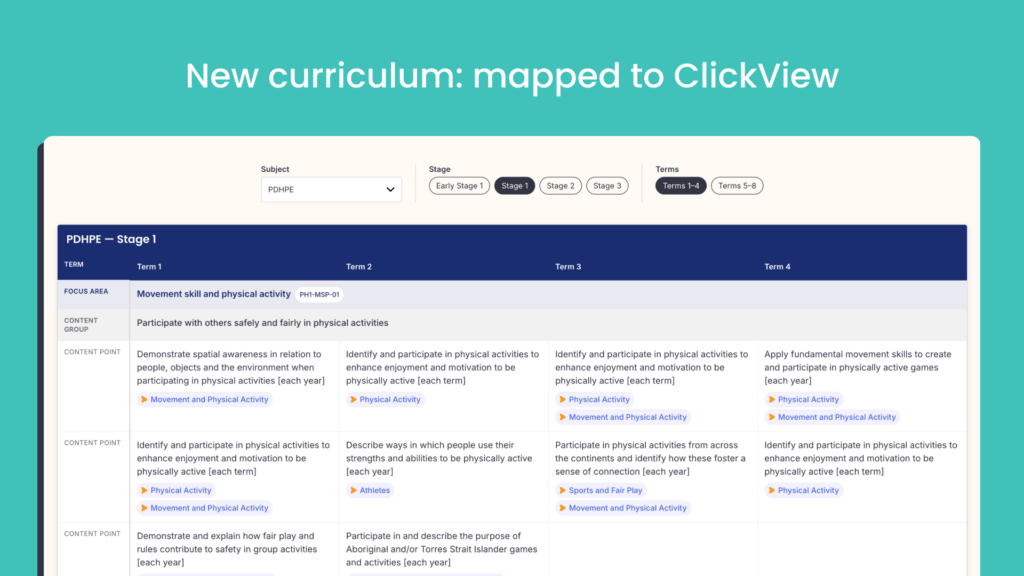
Access the NSW K–6 scope and sequence guides
What’s inside the guides?
Each guide helps teachers see how syllabus content can be sequenced and supported with rich, curriculum-aligned resources.
They include:
- suggested term-by-term sequencing
- aligned ClickView Topics and resources
- opportunities to build vocabulary and knowledge
- links to literacy and writing
- guidance on when content is introduced, revisited and extended
For example, the Science and Technology guide shows progression from early observations of the natural world to later learning about systems, forces, sustainability and space, all supported by relevant ClickView resources.
How to use the guides
The guides are not a mandated program, by any means! They’re flexible planning tools designed to support school decision-making.
They can be used to:
- support whole-school planning discussions
- identify where content is introduced and revisited
- locate supplementary resources during unit planning
- support cross-curricular programming (and there are some amazing opportunities for that!)
- review existing scope and sequences
- build confidence with new content areas
You don’t need to follow them exactly. Adapt them to your context and students.
Learning area overviews
Creative Arts K–6

The Creative Arts syllabus includes Dance, Drama, Music and Visual Arts. Students develop skills through making, performing, composing, listening and responding.
The scope and sequence guide helps teachers organise all four art forms across the year and links to ClickView resources that show artistic processes, performances and techniques in action. Remember to check back every now and then, because there’s always new ClickView content on the way!
HSIE K–6

HSIE combines History and Geography. Students learn about the past through sources and develop understanding of places, environments and sustainability. Compared to the previous syllabus, the new version is more explicit in its content expectations and places a stronger emphasis on the early, systematic development of disciplinary skills such as historical inquiry, use of sources and geographical thinking across all stages.
The guide includes content such as ancient civilisations, First Nations histories and Cultures, government, mapping and inquiry skills, supported by ClickView resources.
PDHPE K–6

The PDHPE syllabus has been updated to place greater emphasis on respectful relationships, consent, personal safety (including online safety), identity, health and wellbeing, alongside movement and physical activity. There are some potentially tricky topics to explore with your students, but don’t worry, we’ve got you covered!
The guide links syllabus content with ClickView resources that support discussion of scenarios, vocabulary and decision-making in age-appropriate ways.
Science and Technology K–6

Science and Technology integrates scientific understanding, inquiry skills, design thinking and digital technologies.
Students progress from observation and questioning to investigation, analysis and design. The guide aligns this progression with ClickView resources across topics such as forces, ecosystems, space, materials and digital systems.
Planning with confidence
Curriculum change takes time, but it doesn’t have to feel overwhelming. Having worked in education for about 20 years now, I’ve seen first-hand how curriculum shifts are not just moments of adjustment, but genuine opportunities to pause, reflect and refine what we do in the classroom.
While change can initially feel demanding, it also creates space to review long-standing programs, strengthen sequencing, and ensure that what we teach is truly meeting the needs of today’s learners. These guides are designed to give schools a clear starting point for planning and resourcing to help you do just that.
Use them to support discussion, guide sequencing and save time finding relevant classroom resources. Most importantly, adapt them to your context!
The goal is to make planning more manageable so teachers can focus on what matters most—supporting student learning.
Ready to prepare your school for the new NSW K–6 curriculum? Reach out to our friendly ClickView team to see how we can help you.
Share to

Rebecca Langham
briefcase iconCurriculum Specialist
Rebecca Langham is a Curriculum Specialist at ClickView, bringing more than 20 years’ education experience spanning roles such as secondary teacher, school leader, curriculum advisor and published writer.
Other posts

Want more content like this?
Subscribe for blog updates, monthly video releases, trending topics, and exclusive content delivered straight to your inbox.