
How to Plan a Lesson in 6 Steps with ClickView
Published on 6 min read
Written byPeter Thomson
In this guide
From creative, exciting lesson plans for early years to challenging, thought-provoking lesson plans for senior students, we are passionate about increasing student engagement in the classroom. Here we show you how our lesson plans are designed to meet professional teaching standards and address the needs of our learners, so that you have a solid platform for creating your own engaging lessons.
1) Start with a Lesson Objective
Consider each lesson as a step leading towards your overall assessment. Each step will teach the students a skill and/or deepen their understanding of a topic that will enable them to complete the assessment.
For example, if your assessment item is to write an essay, the steps leading up to the assessment would be:
- Learn essay structure with examples
- How to write an introduction, body and conclusion of an essay
- How to accurately address the essay question
- Practice attempts at writing an essay
- Final assessment
On our Teaching Resource page, you have access to ready-made lesson plans for all primary and secondary grades and subjects. If we open the “Lesson Plan Book Science Year 7,” on page 8, you can see the first lesson plan beginning with the objective as follows:
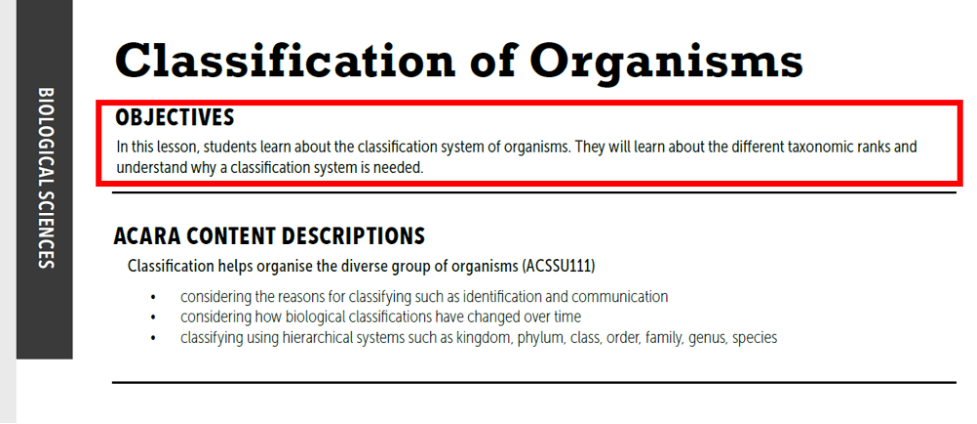
The unit of work is on the classification of organisms in Biological Sciences. The first step is to learn about classification systems. By the end of the unit, students will be assessed on their attained knowledge of classification systems by creating and explaining a food chain.
2) Meeting Standards
You will be required to teach to Australian curriculum (ACARA) and your state’s standards, which can be found in your subject’s syllabus documents. Your students will be taking standardised tests (e.g., NAPLAN) throughout their school career and the standards identify appropriate academic outcomes for each stage of their learning.
It is only beneficial during meetings with your head teacher or principal to be able to demonstrate how you have linked you lesson plans to syllabus outcomes. This is evidence of your professional practice and appropriateness of the lessons you have been teaching.
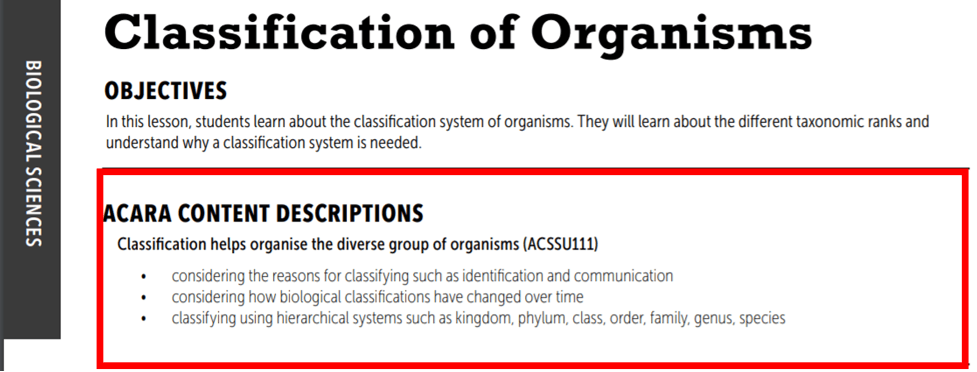
Using the same example as before, you can see how ClickView maps every lesson to appropriate syllabus and curriculum outcomes. This ensures that the content you use in the classroom is giving your students the knowledge and skills they need to succeed throughout their school life.
3) Learning Activities
The next stage in lesson planning is to decide on a series of activities to introduce new ideas and allow your students to practice and experiment with what they are learning. Some of your classes will be able to sustain their focus over a period with only two or three activities. Other classes may require you to use a wider variety of activities to keep their engagement and motivation.
It is also important to consider:
- How much preparation an activity will require
- How easy it will be to implement it in the classroom
- How long it should (ideally) take your students to complete.
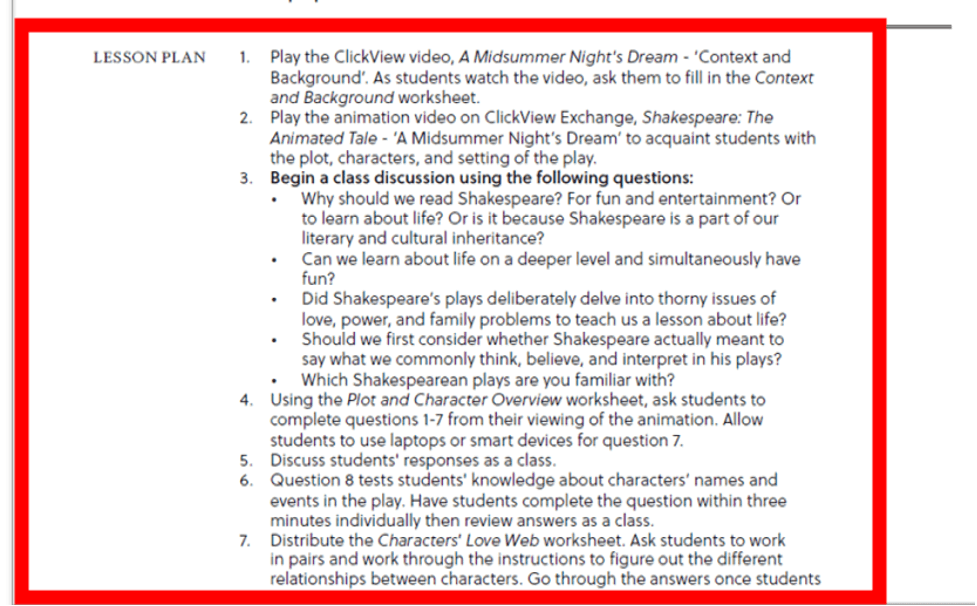
From page 3 of “Shakespeare: Lesson Plans for the ClickView Curriculum Library,” A Midsummer Night’s Dream – ‘Context and Background’ lesson, you can see an example of the lesson’s learning activities detailed in sequential order.
You can use as much or as little detail of activities as you like but if you have any intention to reuse your plans in the future, you should try to make sure that it is suitably detailed. Although this can be time consuming, you can see from the above example that any teacher could pick up this lesson plan and run the lesson without any confusion.
4) Resources
The availability of resources from school to school are going to vary greatly. Teachers at Bourke High School will face a different set of challenges when designing their lessons compared to teachers at Melbourne High School.
Resources to take stock of include:
- What is on offer at your school
- What your colleagues and predecessors have made
- What your students can bring to class
- Online, video and computer resources
- How the community can help
- What resources you can make for teaching (also consider cost incurred by you)
Select the resources that you will need to facilitate your learning activities and have them ready to go before class.
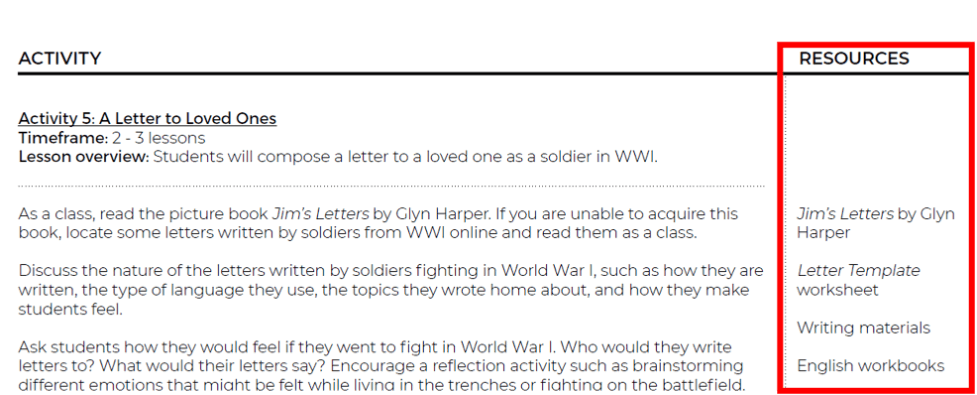
This is an example from page 9 of the “Australian Celebrations and Commemorations: Remembrance Day” Teacher’s Pack for Year 3 students History lesson. In this example, the “Jim’s Letters” book by Glyn Harper would come from the school library, the letter template is supplied by the teacher, and students would use their own writing materials and workbooks.
It is always a good idea to carry spare pencils and writing paper in case they do not have any. You could also collect student’s books at the end of the lesson if your class is not great at bringing their own equipment. Have any online resources, video and audio equipment cued up and ready to go before class; you should definitely have a plan B for when technology fails (unfortunately, most of us find this out the hard way).
5) Differentiation
Because no two students in your class will be exactly alike, it stands to reason that their learning styles, motivations, strengths, and weaknesses will be different. As such, a one-size-fits-all approach sets some students up to fail before your class begins. It is important to accommodate for the different learning styles that your diverse set of learners have when you design your lessons.
This could include:
- Use of individual, pair, small-group and whole-class activities
- Presenting instructions in a variety of ways
- Allow activities to be completed in different ways
- Plan varied activities (reading, writing, listening, visual, speaking)
- Allow devices when possible
- Use a variety of assessment
- Provide feedback in different forms
- Allow students to give feedback on their learning
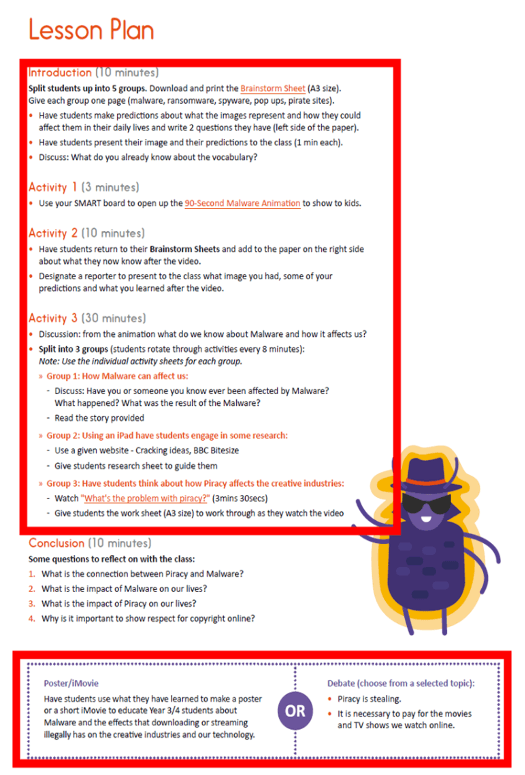
In our Year 4-6 Cyber Safety: Understanding Malware lesson plan, you can see how you can easily facilitate differentiation by your choice and sequence of activities.
- The use of small groups in the brainstorming warm-up allows the teacher to assess background knowledge in a non-confrontational, peer supported manner.
- The activity allows students to communicate ideas orally, visually and in written format and to negotiate roles to suit their learning styles when it comes to the class presentation.
- The video presentation is visually captivating and conveys straightforward information about types of Malware in a short, digestible clip.
- The next activity allows groups to reassess and build on their knowledge by allowing each student to convey their own ideas on what they picked up from the video in their original group.
- Finally, the class is divided in to 3 groups that rotate through varied activities while sharing their combined ideas from smaller groups to consolidate deeper understanding of the topic.
The assessment item allows students to choose between designing a poster (suitable for students who prefer visual and written styles of learning) or a debate (good for students who prefer to verbally demonstrate what they have learnt).
6) Assessment
The final consideration you should make when designing lessons plans is incorporating assessment. You should look to include a form of assessment in you lesson plan to gage the developing skills and understanding of your students as they work through class activities. This will allow you to identify any gaps in student knowledge, skills that need further development and activities that are working or not working.
Formative assessment refers to your ongoing assessment over a unit of work and includes:
- Quizzes
- Questioning
- Feedback
- Teacher observation
- Class discussions
- Written questions and answers
- Homework
- Student demonstration
- Reflection
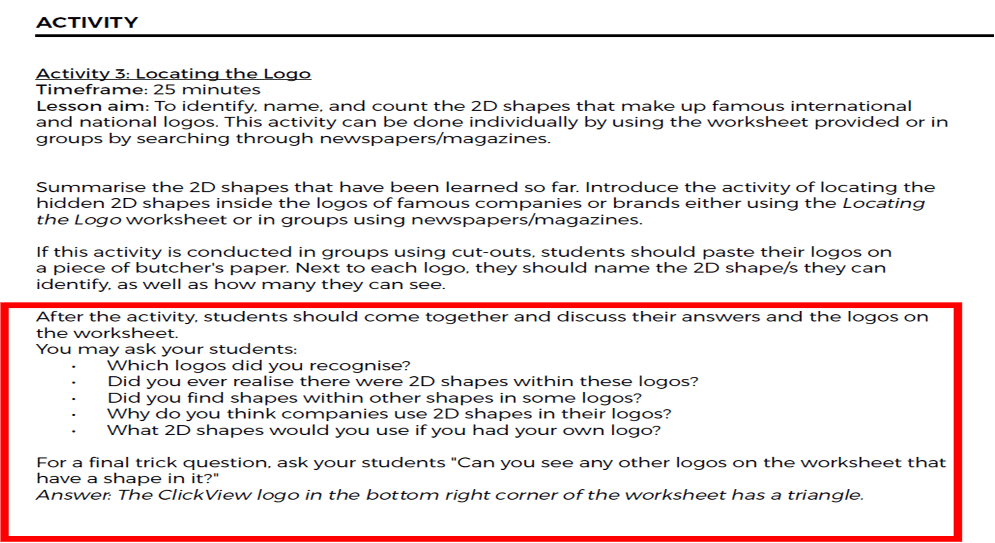
From page 5 of our Teacher’s Pack in the Year 2 Mathematics lesson on “Describing 2D Shapes,” you can see questions that have been included to evaluate the students’ grasp of topics from the lesson.
Formulating questions before the lesson will help you to target the information you’re after easily and direct class discussions with better structure.
For further tips on how to incorporate academically enriching and engaging video content into your lesson plans, visit our Training Page. You will find extensive lesson plans and teaching resources to help you start lesson planning more effectively.
Share to
Other posts
Want more content like this?
Subscribe for blog updates, monthly video releases, trending topics, and exclusive content delivered straight to your inbox.