
The Case for Purposeful Video
Published on 3 min read

I remember the exact moment I understood what video could do in a classroom.
I was in elementary school, sitting in the library for Junior Great Books. Our librarian had set up the Dukane projector, filmstrip loaded and cassette tape cued, to show us an adaptation of Edgar Allan Poe’s “The Tell-Tale Heart.” The film was grainy. The audio was tinny. And it was one of the most effective teaching moments of my life. Not because of the technology, but because of what our librarian did with it. He kept his hand near the stop button. Every time the story reached a difficult passage, he paused it and asked us a question we couldn’t answer without thinking hard. The video wasn’t the lesson. The pause was.
I’ve carried that moment with me through decades as a student and then as an educator, and I keep returning to a simple conclusion: purposeful use of video is one of the most powerful tools we have for helping students build a genuine connection to learning. Passive use of video is not. The difference has nothing to do with the technology and everything to do with the intention behind it.
In third grade, our teacher wheeled a TV into the classroom so we could watch the Challenger launch live. What followed was one of the great acts of teaching I ever witnessed. In the immediate aftermath of a tragedy, unplanned and unrehearsed, she turned that screen into a classroom, and the lessons she drew out of that moment have stayed with me for forty years. That’s not passive consumption. That’s a teacher present enough to meet students where they are and make something lasting out of it.
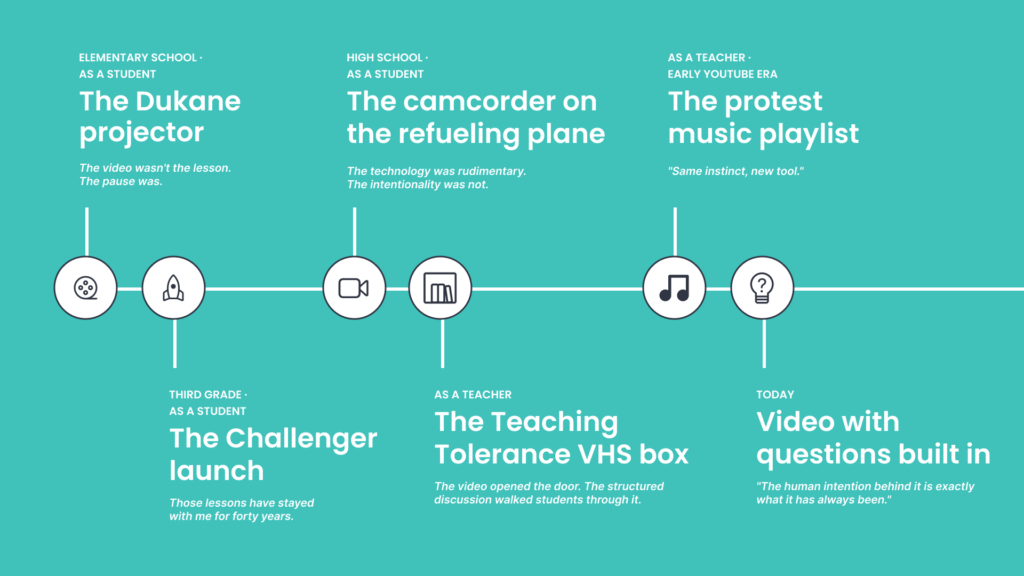
My high school design teacher took that instinct further. He boarded a New Jersey Air National Guard refueling plane with a camcorder and spent a flight recording a mid-air refueling operation, interviewing crew members throughout the process. He came back with a video that walked us through something we could never have experienced in a classroom. The technology was rudimentary. The intentionality was not.
As a teacher myself, my most prized possession was a box of VHS tapes from Teaching Tolerance, each one paired with a lesson and discussion guide that taught students how to break down complex human interactions. Twenty-plus years later, those tapes and books are still in a crate in my attic. I haven’t owned a VCR in fifteen years, but I can’t bring myself to get rid of them. The guide books were the point as much as the tapes. The video opened the door. The structured discussion walked students through it.
My first use of YouTube in the classroom was building a playlist of protest music spanning the 1920s through the present, not to fill time, but to give students a way to compare and contrast how young people have always used music to respond to the world around them. Same instinct, new tool.
Now I watch teachers embed annotations, discussion prompts, and comprehension questions directly into video, tying an Oprah Winfrey and Elie Wiesel interview at Auschwitz to Wiesel’s novel Night in ways that would have required a librarian’s pause button and a lot of patience a generation ago. The interactivity is built in now. But the human decision behind it, to use video as part of learning and not as a substitute for it, is exactly what it has always been.
The technology has changed dramatically since those filmstrips and VHS tapes. The core idea has not. Purposeful video helps students slow down, unpack complex ideas, and build a deeper connection to what they are learning.
Share to

Tim Powers
briefcase iconRegional Director - US
A lifelong educator and curriculum specialist, Tim has built his career at the intersection of teaching, learning, and educational technology. He spent six years in the classroom as a middle and high school History teacher, where he developed a strong commitment to inquiry-based and project-based learning. That foundation guides his work today as he helps teachers and students use digital tools to deepen thinking, spark curiosity, and make complex concepts easier to unpack.
Other posts


Want more content like this?
Subscribe for blog updates, monthly video releases, trending topics, and exclusive content delivered straight to your inbox.