
4 Essential strategies to use when teaching reading
Published on 12 min read


In this guide
Important considerations when teaching reading
Reading can seem like a daunting subject to teach. This is made especially true because typically all students in a class are not on the same reading level.
Using evidence-based instructional strategies is a top priority when teaching reading. We cannot just use a strategy because we like it, but we must use the strategies backed by research. These are strategies that are practices consistently associated with positive learning outcomes.
Student reading and comprehension levels are two important considerations when approaching reading. What can your students handle? What accommodations and scaffolding must you do to make the materials accessible to every student?
There is a wide range of skills and levels within every classroom – no matter the grade or age of the students. This means that the teacher must determine what their students’ needs are before teaching a text.
Each of the strategies outlined below, can be modified for your students’ needs. I have included suggestions for these modifications for your consideration.
I would like to suggest that teachers attempt the activities outlined more than once. As a former instructional coach, I have made many suggestions. One of the biggest hurdles my teachers and I would overcome is trying something more than once.
If something does not work the first time, the immediate reaction is to never do it again. However, reflection and adjustments can make a failed activity into a fruitful learning experience. Taking time to reflect on our practice and to make needed modifications, is pivotal to our success as educators.
Reading is a process that has steps, therefore, teaching reading is the same. When students have specific steps to follow, they comprehend and absorb more of their reading. Students can focus on understanding rather than process.
Strategies for each part of the reading process can be organized into clusters:
- Setting a purpose for reading
- Pre-reading and vocabulary
- During reading
- Response to reading

Strategy #1: Setting a purpose for reading
Identifying the author’s purpose for writing helps us to then create a purpose for reading. By asking questions such as “Why did the author write this text?”, or “What does the author want me to know after reading this text?” can help set the purpose for students.
Often we teach that there are three purposes for a writer to create a text – to persuade, to inform, and to entertain. While these are three possible reasons for writing, the purpose of a text does not always fall into a specific category. A text could be written to predict, to express emotion, to celebrate, etc.
I live in Texas and our state standards (TEKS) require that a student “(A) analyze the author’s purpose, audience, and message within a text; and (B) evaluate use of text structure to achieve the author’s purpose” (ELA 11.8.A-B Texas Essential Knowledge and Skills). This standard is repeated in each grade level, however, in lower grades it adds the caveat of “with adult assistance.”
In addition, many states in the United States have adopted the Common Core State Standards. These standards require that students assess how point of view or purpose shapes the content and style of a text.
Students must have the skills to identify the author’s purpose and how that purpose impacts the text in order to fulfill required state standards.
It is the role of the teacher to model for students the skills needed to identify the author’s purpose for writing a text. A teacher does this by exploring genre and identifying themes found within a text.
Activity #1: Genre graphic organizer
By highlighting the relationships between key concepts, graphic organizers help readers visually organize and understand information.
Directions:
- Teacher models using a graphic organizer to help students recognize the genre characteristics found in the text.
- Examples and traits of the genre should be included.
*This should not become a copying assignment and students should be able to use the graphic organizer independently.
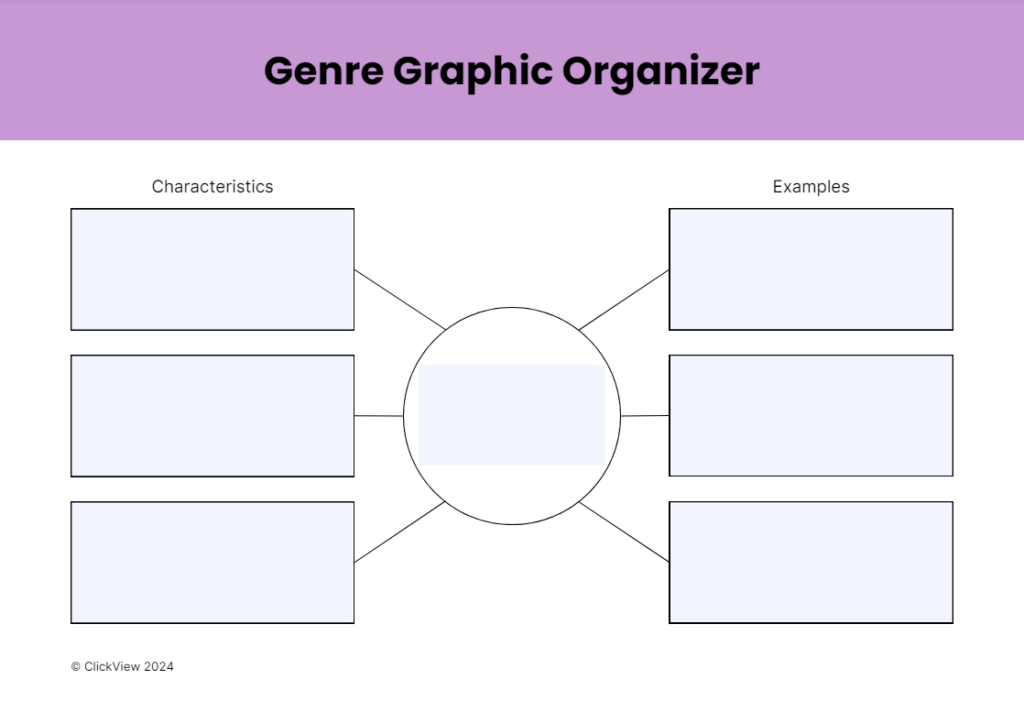
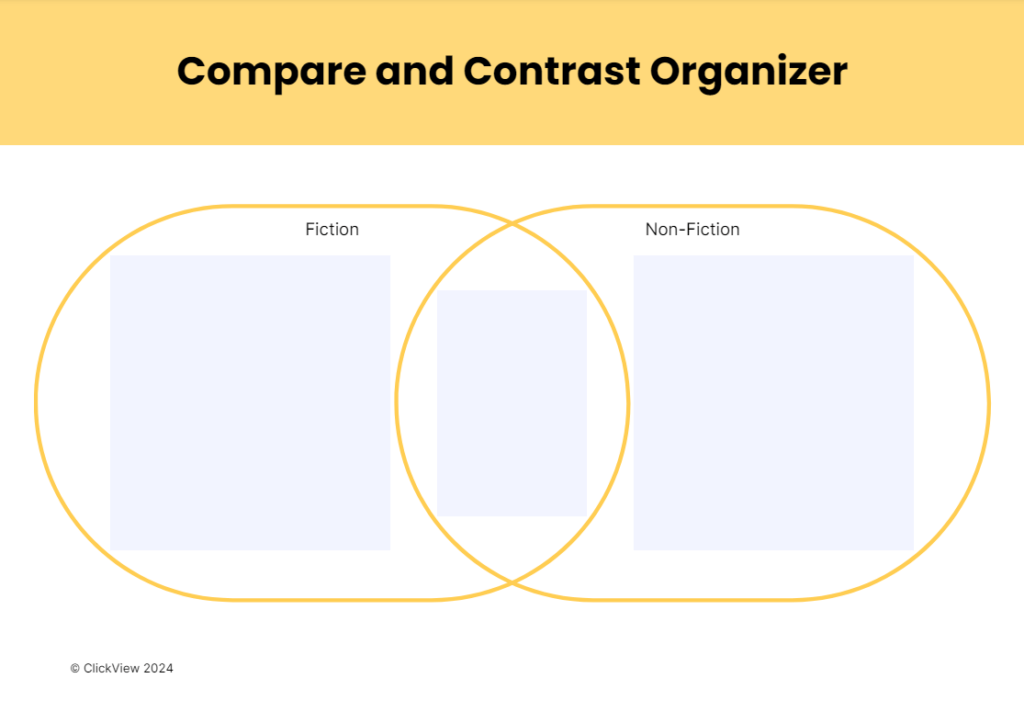
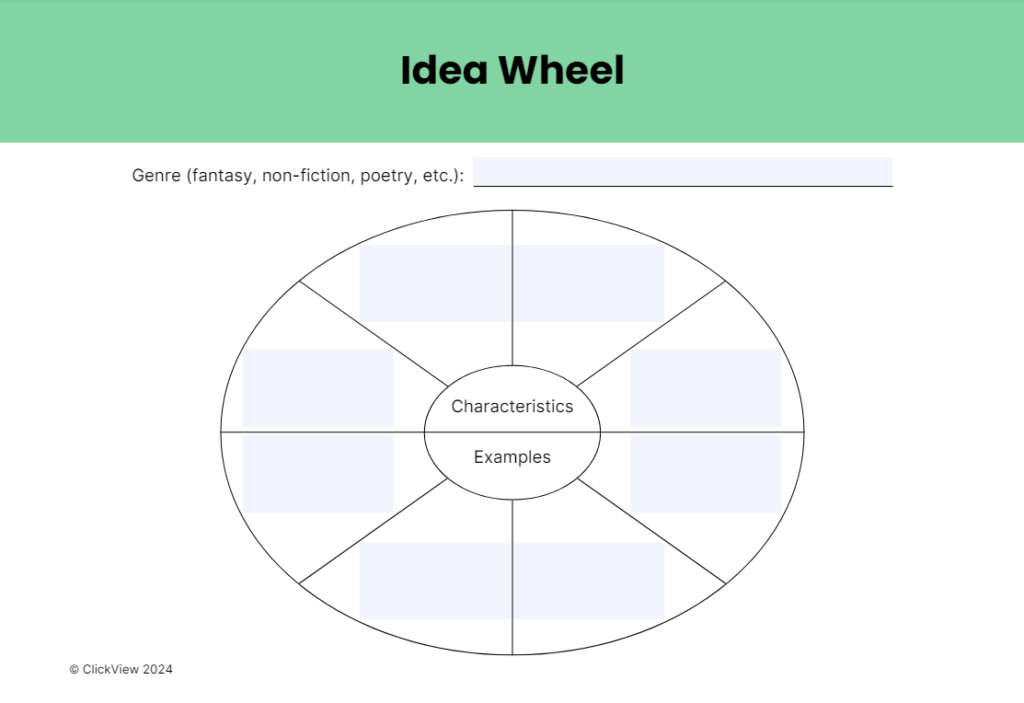
Examples of genre graphic organizers with links that can be used with students:
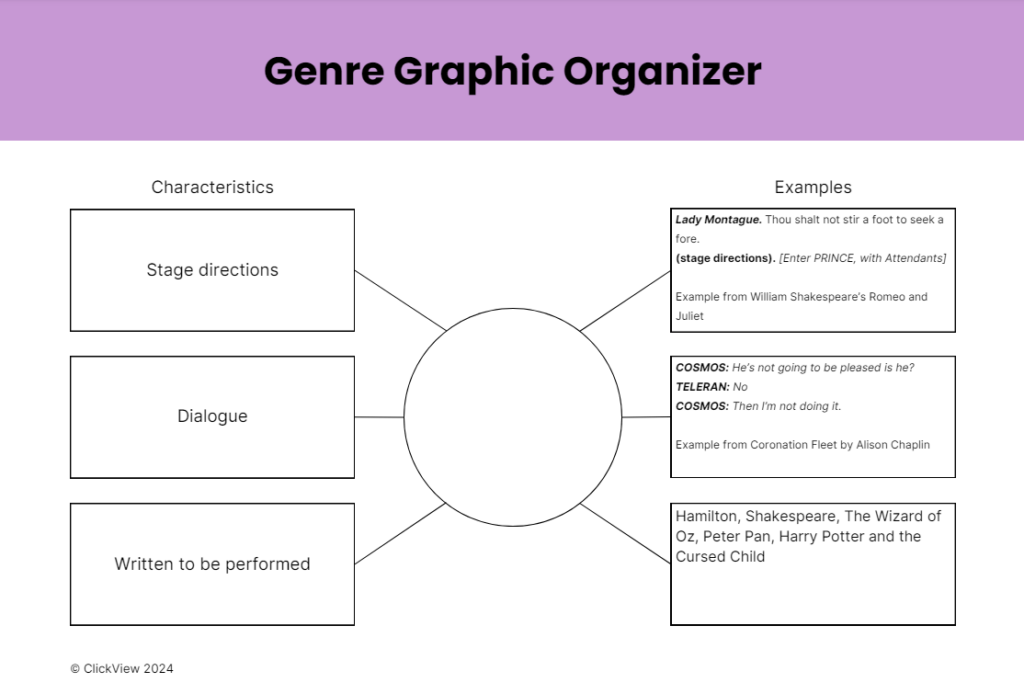
Example of a completed graphic organizer:
Activity #2: Anchor charts for genre and theme
Anchor charts do what they say, they “anchor” students’ learning. They are a visual reminder of information learned.
Ideally, anchor charts are created with students and are referred back to frequently.
I am no artist, but I have included a few examples of anchor charts that I have used in my classroom. These particular anchor chart examples apply to genre and theme, but anchor charts can be used for a multitude of purposes.
Teachers can add pictures and graphics. Students can add information through the use of sticky notes.
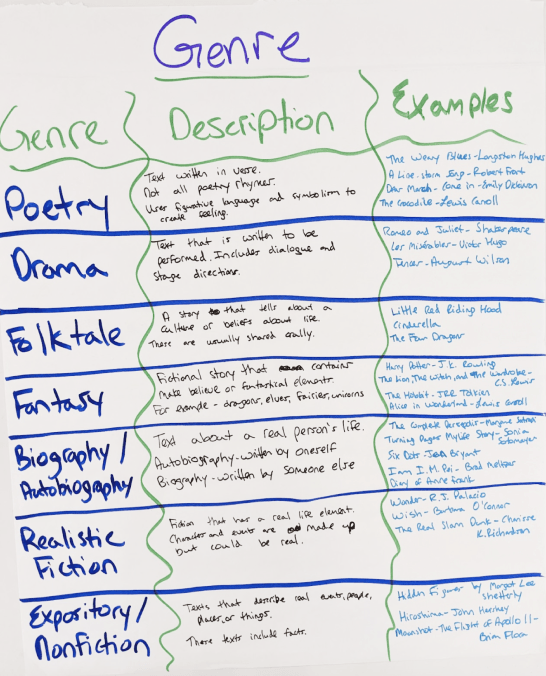
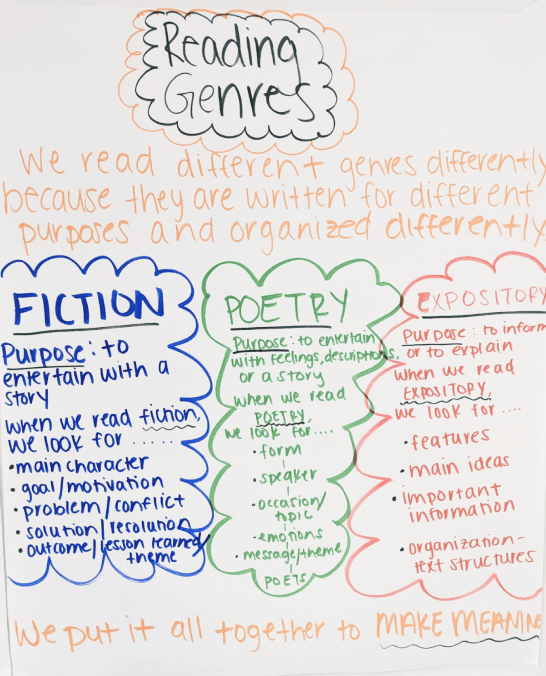
Genre anchor chart examples
This first example can be modified for any grade level despite being created for a secondary classroom. Grade appropriate language and literature could be added according to your needs.
This chart can be referred to throughout the school year as different genres are explored.
This more simplistic chart is more appropriate to an elementary classroom:
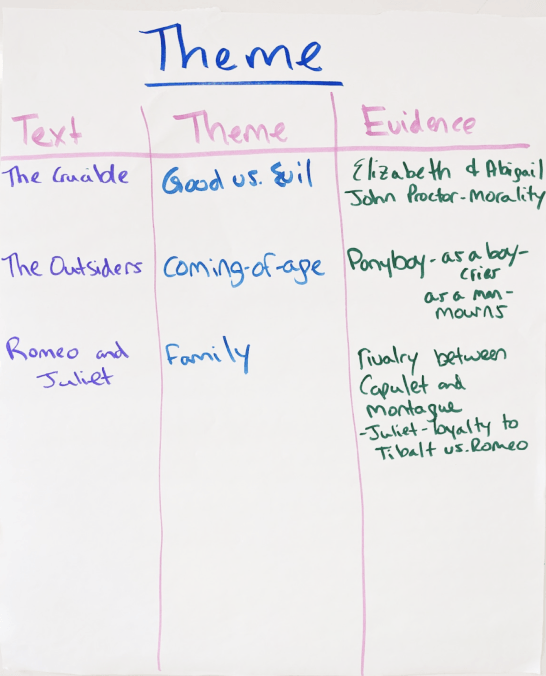
Theme anchor chart examples
Theme helps students to recognize the message the text is conveying.
Depending on the length of a text, the theme can apply to the entire text or only sections.
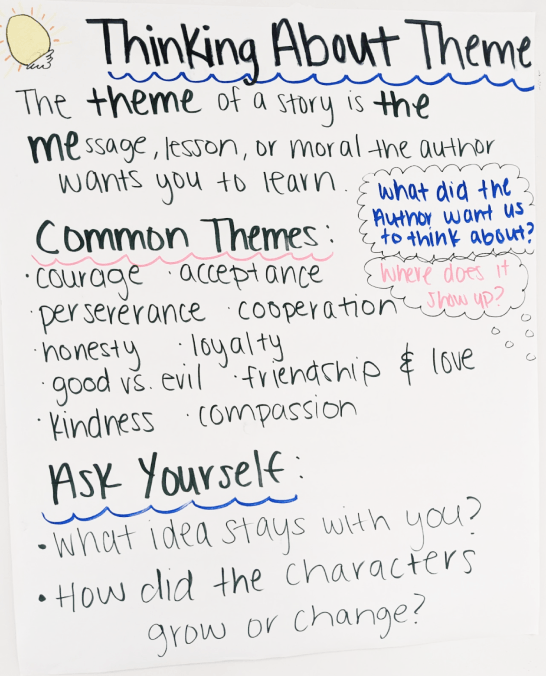
The second theme anchor chart gives the opportunity for the teacher to model how to give evidence from the text to support the theme:
Activity #3: Author’s purpose classifying activity
Directions:
- Teacher creates cards with examples of texts. (10-12)
- Students sort the cards according to the author’s purpose.
- Students give a justification (oral or written) for their classifications.
To make this more challenging for higher level students, the students can create the categories for classification.
Another way to make this more challenging is to have examples from texts, not just types of text.
Here are some examples you can use in your lessons.
Strategy #2: Pre-reading and pre-teaching vocabulary
Pre-reading strategies provide the teacher a chance to spark students’ excitement and interest in a text. This is also when we activate background knowledge.
For pre-reading strategies to be important they must be short and focused on the important elements of the text. Important vocabulary should be highlighted for students as well. Spending too much time on pre-reading can lead to students becoming bored with a text before it is even read.
Sometimes, teachers need to build background knowledge for students. Students do not all have the same experiences or opportunities, so we have to scaffold for them.
When students can meaningfully connect to a text prior to reading, they are more likely to be engaged while reading. These connections also help with comprehension.
Activity #1: Activating prior knowledge – 2 minute setting sketch
This activity allows students to be creative and gives the teacher an idea of students’ base knowledge.
Directions:
- Give students a blank sheet of paper.
- Set a timer for 2 minutes.
- Instruct students to draw what they think a particular setting looks like.
Examples: a forest for The Hunger Games, a mansion by a lake for The Great Gatsby, a farm for Charlotte’s Web.
After the setting has been explored in a particular text, students can add to their sketch to include specific information about the setting. Adding information learned about a setting allows students to build background knowledge for future texts.
Activity #2: Pre-teaching vocabulary word sort
Pre-teaching vocabulary can increase comprehension, especially for struggling readers or language learners.
Specific word instruction includes reviewing new vocabulary words before reading and by providing time when students can work actively with new words.
Joan Sedita
There are a few guidelines teachers should follow when selecting words to pre-teach:
- Only select a few words. 5-7 words is ideal.
- Choose words with the greatest impact. These should be words that directly impact the text’s meaning or ones that might be difficult for a majority of students.
- Words that have multiple meanings should be pre-taught. The meaning as it relates to the context of the text is important for students to know.
- Student-friendly definitions should be used.
This activity is useful after the teacher has directly taught the meaning of the vocabulary words. It can also be used after reading to reinforce use of the words.
Directions:
- The teacher creates word cards for sorting: vocabulary word, student-friendly definition, and a sentence.
- Students sort the words matching the vocabulary word to the definition and example sentence.
Students in upper grades can create the word cards for themselves or for other students. Students can also use direct quotes from the text that contained the vocabulary word.
Here is a sorting mat and cards template.
Strategy #3: During reading
Activities done during reading are often ignored. We want to get the text read in a timely manner. After spending significant time on the pre-reading activities, we hesitate to “waste time” during reading.
However, pausing during reading to engage students with the text can allow for better responses later. Students must learn how to make inferences and connections within and across texts.
The discussion of good books with their friends and classmates is one avenue for making these connections. Such discussions will help children to appreciate and reflect on new aspects of written language and on the wide, wonderful world of print.
Texas Education Agency
Keeping students engaged in a reading assignment can prove to be a difficult task. This is especially true of long or challenging texts. Including a few short activities during reading can help to improve their engagement.
Activity #1: Turn and talk
This short activity allows for students to verbalize their learning. This is especially useful for language learners and students that are still developing their response skills.
Directions:
- Pose a question related to the text. This question should elicit conversation – not a yes/no question.
- Students turn to a partner and answer the question.
Suggestions:
- Give a time limit (no more than 2 minutes).
- It can be helpful to set parameters so both partners talk. Designating an A partner and a B partner is an easy way to address this concern.
- To help students stay on topic, provide sentence stems relevant to your question.
- An example of figurative language in this section is ________________.
- The author uses the word ____________ to convey _______________.
- I agree/disagree with ____________ because__________.
Activity #2: Thinking mats
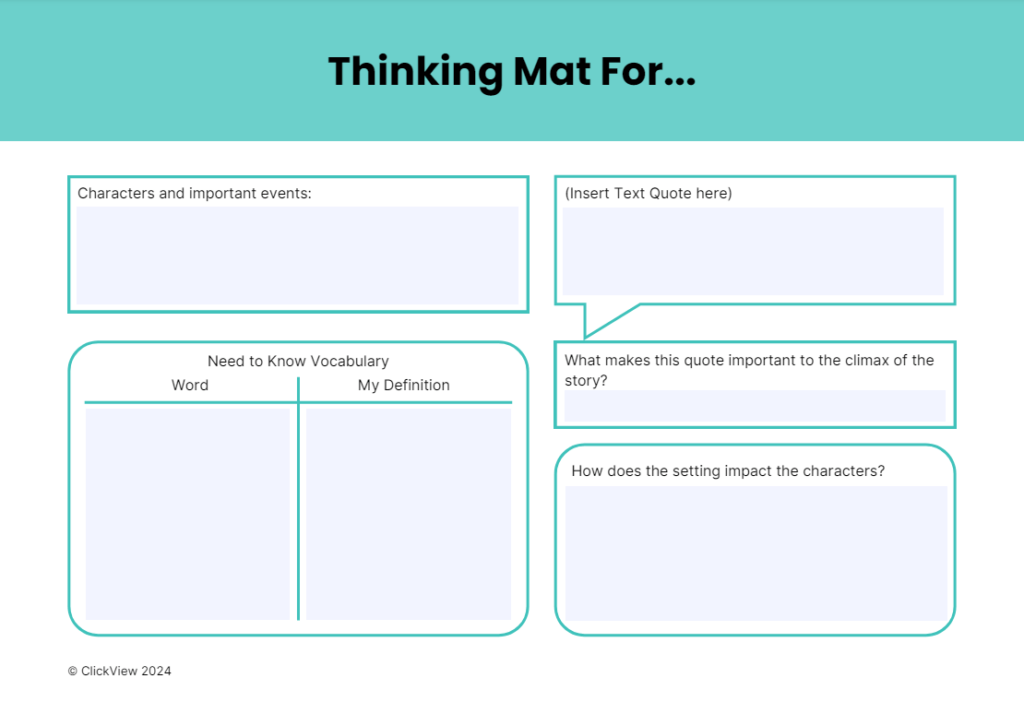
These are something I was shown a few years ago by an amazing English teacher. I took the physical mat she had created and made a digital version. This digital version can be customized to fit any grade level or text.
Students can work in a digital format, or the mats can be printed for student use.
I have included a completed example, as well as a blank example below.
Activity #3: Important word
This activity is especially useful during a second reading when students already have knowledge of the text.
Directions:
- While reading students highlight/underline what they think is the most important word in each paragraph/section/stanza.
- In partners/groups, students come to a consensus on the most important words for the reading and why.
- Create a class chart identifying the important words and their rationalizations.
Strategy #4: Response to reading
Responding to reading in a meaningful way can deepen student comprehension and retention.
Students can make a connection to the text and this looks different depending on student levels.
A significant way for students to respond to reading is through writing. This form of response can be referred to as “writing to read”.
The following activities address this idea of writing to read. Students are responding to a text through different written responses that engage the student in analyzing and understanding the text.
Activity #1: Quiz the next class
This activity gives students the chance to be creative and allows them to analyze a text from different angles.
Directions:
- After reading a text, students create two multiple choice test questions about the text.
- These questions are used to “quiz” other students about the text.
- To increase rigor or for higher level classes, students can create written response questions or other challenging question types.
This activity can be done individually or in groups:
- Individually – The test questions can be collected by the teacher and used to create a quiz for the students.
- Group – Each group writes their questions on a piece of chart paper. Using the gallery walk format, groups rotate around the room and answer the questions on their own piece of paper or sticky notes.
Activity #2: Sentence stems for written/oral response
Students can struggle knowing where to start when constructing a response. Sentence stems help by giving a starting point.
The use of sentence stems for written/oral response is especially useful for students that are language learners or who have a limited vocabulary.
Scaffolding is important with the use of sentence stems. We do not want students to become so reliant upon their use that they are unable to produce writing on their own. Teachers must decide when sentence stems are appropriate.
Directions:
- Teacher assigns students a written/oral response question.
- The teacher provides a sentence stem for students to construct their response.
Examples of sentence stems: This is just one resource, but there are many to choose from. Teachers can also create their own sentence stems.
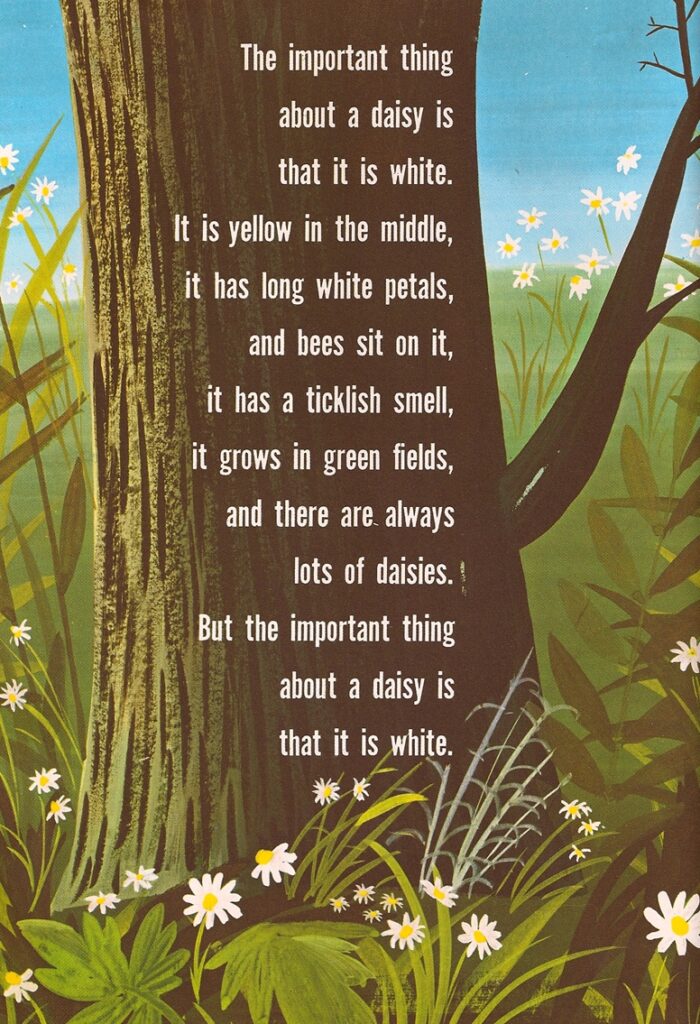
Activity #3: The important thing about…
This activity involves reading a children’s book: The Important Book by Margaret Wise Brown. The writing portion of the activity can be modified to be done with students at any level. I have done this activity with students at the middle and high school levels.
To modify for upper level students, I required more complex sentences and subject matter.
There are online videos a teacher can use to share The Important Book with students if it is unavailable physically for the teacher to read aloud.
Directions:
- Teacher reads The Important Book by Margaret Wise Brown.
- After reading, the teacher models how to create an “important” paragraph about a given subject (character in the text, genre, setting, a particular scene, etc).
- Students are assigned a specific topic and create their own “important” paragraph.
Elementary example:
The important thing about poetry is that it is written in stanzas.
It sometimes rhymes.
It uses figurative language.
It shares feelings and emotions.
It is sometimes hard to understand, but the important thing about poetry is that it is written in stanzas.
Secondary example:
The important thing about Hamlet is that it is a tragedy.
It was written by William Shakespeare.
In a tragedy there is a lot of death.
It has themes of corruption, deceit, and mortality.
It is about Hamlet wanting to avenge his father’s death.
It has the ghost of his father, but the important thing about Hamlet is that it is a tragedy.
Activity #4: Theme with evidence
This activity is a written response where the student uses evidence to support their conclusion about the theme. Using evidence to support responses is a vital skill for students to learn.
Directions:
- Teacher creates a written response prompt about the theme.
- Give two pieces of evidence to support the theme of _________ in _________.
- Use textual evidence and reasons to support the theme of _________ in ______.
- Students write a paragraph in response to the prompt.
- The paragraph follows the pattern:
- Introduction and statement of the theme
- 1st piece of textual evidence
- Reason the evidence supports the theme
- 2nd piece of textual evidence
- Reason the evidence supports the theme
- Conclusion
For lower grade levels or students who are not writing independently the teacher would do this activity as a whole class. The teacher would model how to construct this paragraph.
For upper grade levels, the teacher would model this process and then expect students to complete independently.
References
- Thinking Stems https://lead4ward.com/resources
- Wise Brown, Margaret. The Important Book. Harper Collins, May 25, 1949.
- Texas Essential Knowledge and Skills for Reading Language Arts. Texas Education Agency.
- Common Core State Standards for English Language Arts. Common Core State Standards Initiative.
Genre Graphic Organizer:
Share to

Mattie Farrer
briefcase iconAVID Site Coordinator / Content Curator
Mattie Farrer has been an educator in various grade levels and capacities during her career. She has a passion for supporting English learners and their language development. She also loves helping teachers reach all students.
Other posts



Want more content like this?
Subscribe for blog updates, monthly video releases, trending topics, and exclusive content delivered straight to your inbox.