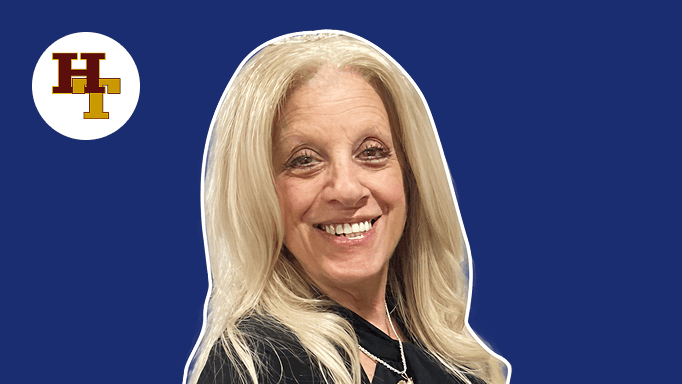
Michell McNeill
"Some ideas can be difficult to picture, but video allows students to truly see and better understand."
Michell McNeill, Director of Instructional Technology
Johnson County Public School District
Smithfield, NC


What is a recent initiative in your district where digital and hands-on learning came together to help students grow?
The new science standards require engineering design practice. Incorporating the Engineering practice in learning is sometimes hard for teachers to really get a handle on, which makes it difficult to provide more hands-on learning experiences. While not every school has a designated STEM teacher, where budgets allow, these teachers model ways to naturally integrate STEM across classrooms. We’ve seen some students use programs like Canva and Adobe Express, where they’re using that hands-on piece to create podcasts and similar things, and the learning is just so much deeper. All subjects are able to include digital and hands-on learning opportunities and that is one of the areas where our team tries to encourage district leaders, instructional coaches, and curriculum specialists. For instance, how they can make connections with literacy and hands-on learning, or history. One of the projects I’m currently working on is a Holocaust project involving Google Earth, showcasing the different locations and what happened to each area after the Holocaust. Every subject area can benefit. For instance, math can even use Google Earth to measure baseball fields in MLB stadiums and use those measurements to determine the minimum distance needed to hit a home run. Students are able to make a prediction about which baseball stadium will have the highest number of home runs next season, and then use specific evidence to support their answer. Our students have really enjoyed that project.
How are you seeing video-based resources helping students comprehend more difficult concepts?
I think it’s very helpful when students have a way to visualize what they’re learning. Especially when it is embedded in real-world content or jobs. They’re able to see the actual application rather than just hearing us teach a concept or reading about it in a book. Sometimes it’s difficult to visualize, but video actually allows them to truly see and better understand. It also helps when other people are involved because they’re learning from different people and different perspectives. Even just hearing a different voice can help. Sometimes including video might be as simple as recording the process of a math problem and having audio included. Or it may be a math concept and then include the real-world application to reinforce the lesson. I’ve heard people say they haven’t used algebra since they graduated, but that’s not true. We’re solving for the unknown all the time. For instance, there’s a discount on a shirt at the store and I need to know what I’m going to pay for it. That is solving for the unknown. Students do not want someone standing in front of them talking all the time. And, if you have engagement pieces within a video, they can engage with that and learn. If students missed something, they can rewind and listen to it again. Or if a student is really struggling with something, they can slow it down and go step by step and pause it where needed. So even if you are learning how to solve an equation by using video, you have the opportunity to go at your own pace and stop it where you need to and get the reinforcement.
What tools or resources are you most excited to use to strengthen or evolve your curriculum?
AI is on everybody's brain. That is definitely one of our big focuses in the coming years, especially middle and high school students. We also want to change the perspective of teachers who think AI is just a tool for students to cheat with. We want to help teachers and students both use AI in a way that transforms learning. But it’s not just AI, we want to help them transform learning with all of our digital tools. Whether it’s ClickView, or even Adobe or Canva, we want them to be able to create something that they can share with others. We want to help build capacity using those tools, not just for the sake of the tool or to meet an evaluation standard, but to use it effectively. When we went through COVID, I feel like most people used digital tools wrong. There was a mindset of “we have to get this done” and our people weren’t trained properly. No one did it wrong intentionally; we didn’t have time to train, and so it left this negative connotation. Many people say kids shouldn’t be on technology, but the real question is whether they are using it effectively. It’s not just about teachers showing a video. When videos are used, we should consider how they can maximize instructional time and provide students with opportunities to create something that strengthens and deepens their learning. It’s also important for schools to do training on the resources they already have available because I’ve heard many say they didn’t realize we had certain tools, or they didn’t fully understand all the ways a tool could be used within their classroom and now they have a new perspective on how to best utilize it with their students.
With that in mind, how do you spread awareness of the great resources your schools already have?
This year we offered some back to school sessions and traveled to the school whenever they were having their professional development programs. We’ve also taken part in digital learning days at schools. In part it’s spreading awareness about the tools themselves, but it’s also equally important to share how to use them. For instance, showcasing tools we already have that can support our multilingual learners and how they can be tied into modifications or used within different resources. We highlight the tools, resources, and accommodations within that tool that they can use to support a specific modification for a specific type of student, like our English language learners or our exceptional student learners.
What are some educational resources, thought leaders, or influencers that you follow and enjoy learning from?
I’m fortunate to have a lot of local North Carolina educators that have made a huge impact for me. Two colleagues in my office, Dave and Kay, are both absolutely amazing. They have different strengths and backgrounds so I have these amazing experts right here with me. Our State Department of Public Instruction is also amazing and has really created a lot of digital learning networks for us. It allows us to learn from each other, so we’re able to reach out to people in our own state whether they work for the State Department of Public Instruction, or in a school or district role. I feel very fortunate to be able to learn so much from those right here in North Carolina and to be able to reach out personally and ask about projects they’ve worked on. They’re always so willing to share. Molly Holliman is a tremendous library support person in our state. She’s amazing and always gives me great ideas. Jessica Esposito is another great library contact of mine and she is such a visionary. We’ve worked on sustainable development goals together, including a sea turtle project. There’s so many great people that I reach out to for different inspiration and if I start naming names, I know I’ll leave people out. Influencers are great, but these are my real-world people and it’s been wonderful that the State Department of Public Instruction has helped me find my network through their different initiatives and cohorts.

Lightning Questions
1. What book are you reading now?
Personally, I just finished reading Identity by Nora Roberts. Professionally, I am reading The Power of Place: Authentic Learning Through Place-Based Education.
2. Who is the ONE person you follow on social media that you always learn something from or who makes you laugh?
Shannon McClintock Miller, “The Library Voice,” is someone I always learn from. She consistently shares great ideas and creative choice boards. I’ve had the opportunity to meet her, and she was amazing. However, I also follow many educators across North Carolina with whom I’ve connected and built relationships. I find that I can learn just as much from the incredible educators right here, so that’s where I spend the majority of my time engaging and sharing ideas.
3. Favorite tech tool currently?
Honestly, I’d have to say my favorite is my Google Apps Launcher (the “waffle”), because that’s where all my favorite tools live! I regularly use Google My Maps, Google Earth Projects, Google Drawings, Google Drive, Notebook LM, Slides, Sheets, Docs, Vids, Gemini, Classroom, Gmail, Meet, and Forms. And of course, the Calendar is a must in this role! Each of these tools supports creativity, collaboration, organization, and communication, making it impossible to choose just one favorite.
4. What is the best part about your role that others might not realize?
The opportunity I have to break down barriers and personalize learning experiences for both educators and students. I get to inspire creativity, critical thinking, and real-world problem-solving. It’s incredibly rewarding to see educators grow in confidence and students light up with curiosity as they discover new ways to learn and lead in an ever-changing world.
5. What is one piece of advice you've received that has been the most beneficial to your career?
Don’t let the fear of failure become the reason you never tried. Every mistake or challenge is an opportunity to learn and grow. Taking risks and stepping outside of my comfort zone has allowed me to discover new ideas, tools, and approaches that lead to greater success for myself as well as for educators and students. It has also helped me build the confidence to try new things. Some have worked, some haven’t, but each experience has taught me something valuable.