
7 Ways to explore life cycles with your students
Published on 9 min read

In this guide
Why teach life cycles?
Life cycles are one of those topics that naturally spark curiosity. From the moment a student watches a tadpole sprout legs or a seed push through soil, they’re hooked. It’s biology they can see, touch, and follow over time, and that makes it one of the most rewarding subjects to teach in elementary science.
But life cycles also connect to broader scientific thinking. When students compare how a butterfly develops versus how a bird hatches and grows, they’re building skills in observation, classification, and analysis. They’re learning to spot patterns across the natural world, and those patterns form the foundation of life science understanding from elementary through high school.
Whether you’re introducing the concept for the first time in 2nd grade or revisiting it with more complexity in 5th grade, life cycles offer plenty of room to differentiate. The activities below draw on ClickView’s Life Cycles topic resources and cover animals, insects, fish, and plants, so you’ll find something that fits your curriculum and your students’ interests.
Seven activities to explore life cycles in the classroom
1) Start with the big question: what is a life cycle?
Before diving into specific organisms, it helps to ground students in the core concept. What exactly is a life cycle, and why does every living thing have one?
Use the Miniclips video What Is a Life Cycle? (grades 3-5, three minutes) as a short, focused introduction. For a quick refresher or a younger audience, the BBC Bitesize clip on life cycles covers the basics in under a minute.
After watching, try these steps:
- Ask students to draw or describe what they think a life cycle looks like before giving them any definitions. This lets you assess prior knowledge and address misconceptions early.
- Watch the video together, then have students revisit their original drawing or description. What would they change? What surprised them?
- Create a class anchor chart that defines “life cycle” in students’ own words. Keep it visible throughout the unit so you can reference it as you explore different organisms.
This works well as a whole-class warm-up at any grade level. For older students, challenge them to predict how many stages a life cycle might have before they watch.
2) Watch a caterpillar become a butterfly
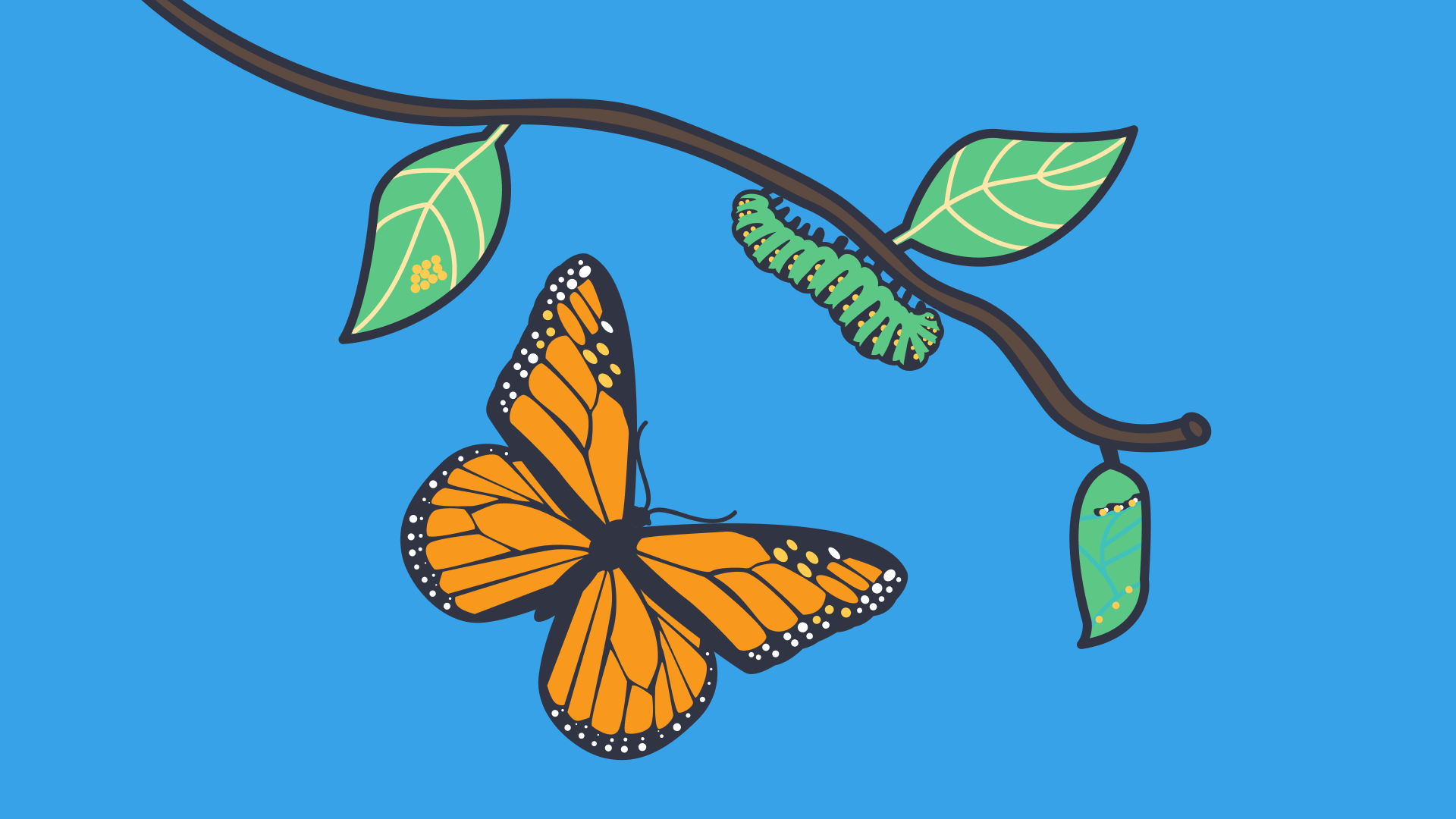
If there’s one life cycle that captivates students across every grade level, it’s metamorphosis. The transformation from caterpillar to butterfly is dramatic, visual, and genuinely fascinating. Why not use it as the centerpiece of your unit?
Start with How a Caterpillar Becomes a Butterfly (grades 1-5, four minutes) to walk students through the stages of complete metamorphosis. Then follow up with Butterfly or Moth? (grades 2-5, five minutes) to get students comparing two insects that undergo similar transformations but end up looking very different.
Here’s how to build the activity:
- After watching both videos, give students a two-column comparison chart. On one side, they record the life cycle stages of a butterfly. On the other, a moth. Where do the cycles overlap, and where do they diverge?
- For younger students, provide a cut-and-sequence activity where they arrange images of the butterfly life cycle in the correct order, then label each stage.
- For older students, introduce the terms “complete metamorphosis” and “incomplete metamorphosis” and ask them to research which insects undergo each type.
3) Compare life cycles across different animals
Once students understand individual life cycles, the real learning happens when they start comparing. How is a bird’s life cycle different from a butterfly’s? What do mammals, birds, and insects have in common, and where do their paths split?
The video The Life Cycle of the Cockroach and the Butterfly (grades 2-5, four minutes) is a great starting point because it compares two insects with different types of metamorphosis. Pair it with Egg-Laying Animals: Birds (grades 2-5, three minutes) and The Chick (grades K-3, six minutes) to bring in a completely different animal group.
Try this approach:
- Create a large classroom Venn diagram (or individual ones for each student) comparing two organisms’ life cycles. For example, butterfly versus chicken. Students identify what’s shared (both hatch from eggs) and what’s unique (butterflies go through metamorphosis; chicks grow gradually into adults).
- Have small groups each research a different animal’s life cycle using the ClickView videos, then present their findings to the class. Afterward, work together to sort the animals into categories: those that undergo metamorphosis and those that don’t.
- For an extension, ask students: “Do all animals start life as eggs?” This question opens the door to discussing live birth in mammals and connects to the video Animal Parenting: Penguins, Birds, Crocs and More! (grades K-5, 16 minutes), which explores how different parents care for their young.
4) Launch a minibeast research project
Spiders, dung beetles, snails: these creatures might provoke a few squeals in your classroom, but they’re also perfect for a hands-on research project about life cycles. Students get to choose a creature, dig into its biology, and present what they learn.
ClickView’s SciShow Kids: Minibeasts series offers short, engaging videos that work well as research starters. Try Don’t Be Afraid of Spiders! (grades 2-5, four minutes), Dung Beetles and Their Big Balls of Poop! (grades 2-5, five minutes), and Snails, Slugs, and Slime! (grades 2-5, six minutes).
Here’s how to structure the project:
- Let each student or pair choose a minibeast from the available videos. They watch the video, take notes, and then research the creature’s life cycle using additional classroom resources.
- Provide a simple research template with prompts: How many stages does this creature’s life cycle have? Where does it live during each stage? How long does each stage last? What does it eat?
- Students create a life cycle poster, diagram, or short presentation to share with the class. Encourage them to include at least one surprising fact.
- Wrap up by discussing as a class: what patterns do you notice across these minibeasts’ life cycles? Are there any stages that seem to show up again and again?
This project works across grade levels. Younger students focus on identifying stages and sequencing, while older students dig into adaptations and environmental factors. You’ll also find more insect-related content in the Insects topic on ClickView.
5) Follow the journey of a salmon
The salmon life cycle is one of the most dramatic in the animal kingdom. These fish hatch in freshwater rivers, migrate to the ocean, and then swim all the way back to where they were born to lay their own eggs. It’s a story of true endurance.
Use the video Salmon Parents Are Amazing! (grades 2-5, five minutes) to introduce the topic. The video follows the full cycle and highlights just how extraordinary salmon parenting is.
Build the activity around these steps:
- Before watching, ask students to predict how far they think a salmon travels in its lifetime. Write predictions on the board. After the video, compare their guesses with the reality.
- Have students map the salmon’s journey on a simple diagram or illustrated map, labeling key stages: egg, alevin, fry, smolt, adult, and spawning. This reinforces sequencing skills and introduces some great vocabulary.
- Connect the lesson to geography by discussing the rivers and oceans salmon travel through. Where in the United States do salmon live? What happens when rivers are blocked by dams?
- For older students, introduce the concept of anadromous fish (species that live in both salt and fresh water) and ask them to research other examples.
This activity ties life science to environmental studies and gives students a window into how human actions affect life cycles. Explore more with ClickView’s Fish and Marine Animals topic.
6) Grow seeds and track plant life cycles
Growing plants in the classroom turns an abstract concept into something students measure, record, and care for over weeks.
The video Seed, Sprout, Plant (grades 3-5, seven minutes) walks students through germination and growth, and even includes experiment ideas around changing variables like light and salinity. Pair it with Mushrooms and Fungi (grades 3-5, three minutes) to show students that not all “plants” reproduce the same way.
Here’s how to set it up:
- Give each student or small group a few fast-growing seeds (bean seeds work well), some soil, and a clear cup so they can observe root growth through the side.
- Have students set up an experiment: one cup gets full sunlight, another gets partial light, and a third stays in the dark. They predict which will grow fastest and record observations daily in a science journal.
- As the plants grow, students sketch each stage and label it: seed, germination, seedling, mature plant. Compare their real observations with the stages shown in the video.
- For a fun twist, after watching the mushrooms and fungi video, ask students: do mushrooms have the same life cycle as a flowering plant? Why or why not? This is a great way to challenge assumptions and get students thinking critically.
This activity naturally spans several weeks, which makes it ideal for building consistency in observation and data recording. It also connects beautifully to math through measurement and graphing.
7) Investigate how bees help plants reproduce
Here’s a question worth posing to your class: what do bees have to do with the life cycle of a plant? The answer leads into one of the most important ecological relationships on the planet.
Start with Why Are Bees Important? (grades 3-5, four minutes) to introduce pollination and its role in plant reproduction. Then layer in How Do Flowering Plants Reproduce? (grades 3-5, one minute) and How Do Plants Spread Their Seeds? (grades 3-5, one minute) for a fuller picture of the plant life cycle.
Try these activities:
- After watching the bee video, have students create a flowchart that connects bees to each stage of a flowering plant’s life cycle. Where does pollination fit? What happens if bees aren’t there?
- Set up a hands-on pollination simulation. Give students cotton balls (the “bees”) and cups of colored powder (the “pollen”). They visit different paper “flowers” around the room and see how pollen transfers from one to another.
- For a cross-curricular connection, tie this into a discussion about food systems. Ask students to list foods they ate today and research which ones depend on pollinators. The results often surprise them.
- Older students can research current threats to bee populations and write a short persuasive piece about why protecting pollinators is so important.
Explore the full Bees topic on ClickView for more resources to extend this lesson.
Tips for ongoing life cycle learning
Life cycles aren’t a one-and-done unit. The concepts thread through science standards from elementary through high school, so building a strong foundation early pays off. Here are a few ways to keep the learning going:
Think about where life cycles connect to other subjects you’re already teaching. A salmon migration lesson ties into geography. A seed-growing experiment reinforces math skills through measurement and data collection. A minibeast research project builds reading and writing skills. The more cross-curricular connections you make, the stickier the learning becomes.
Keep a “life cycle wall” in your classroom where students add new organisms throughout the year as they encounter them in books, videos, or outdoor observations. By the end of the year, they’ll have built a visual encyclopedia of living things and their life stages.
Finally, don’t underestimate the power of observation. Whether it’s a caterpillar in a jar, a plant on the windowsill, or a bird’s nest visible from the playground, real-world encounters with life cycles are the moments students remember long after the unit test. Pair those observations with ClickView’s video resources, and you’ve got a combination that makes the science accessible and engaging for every learner.
You’ll find all of the videos and activities referenced in this guide in ClickView’s Life Cycles topic, along with additional series and resources to support your teaching.
Sources
- National Research Council (2012). A Framework for K-12 Science Education: Practices, Crosscutting Concepts, and Core Ideas. Washington, DC: The National Academies Press.
- Next Generation Science Standards (2013). NGSS Lead States. Next Generation Science Standards: For States, By States. Washington, DC: The National Academies Press.
Share to

Rebecca Langham
briefcase iconCurriculum Specialist
Rebecca Langham is a Curriculum Specialist at ClickView, bringing more than 20 years’ education experience spanning roles such as secondary teacher, school leader, curriculum advisor and published writer.
Other posts


Want more content like this?
Subscribe for blog updates, monthly video releases, trending topics, and exclusive content delivered straight to your inbox.