
Engaging elementary students with US geography games
Published on 6 min read

In this guide
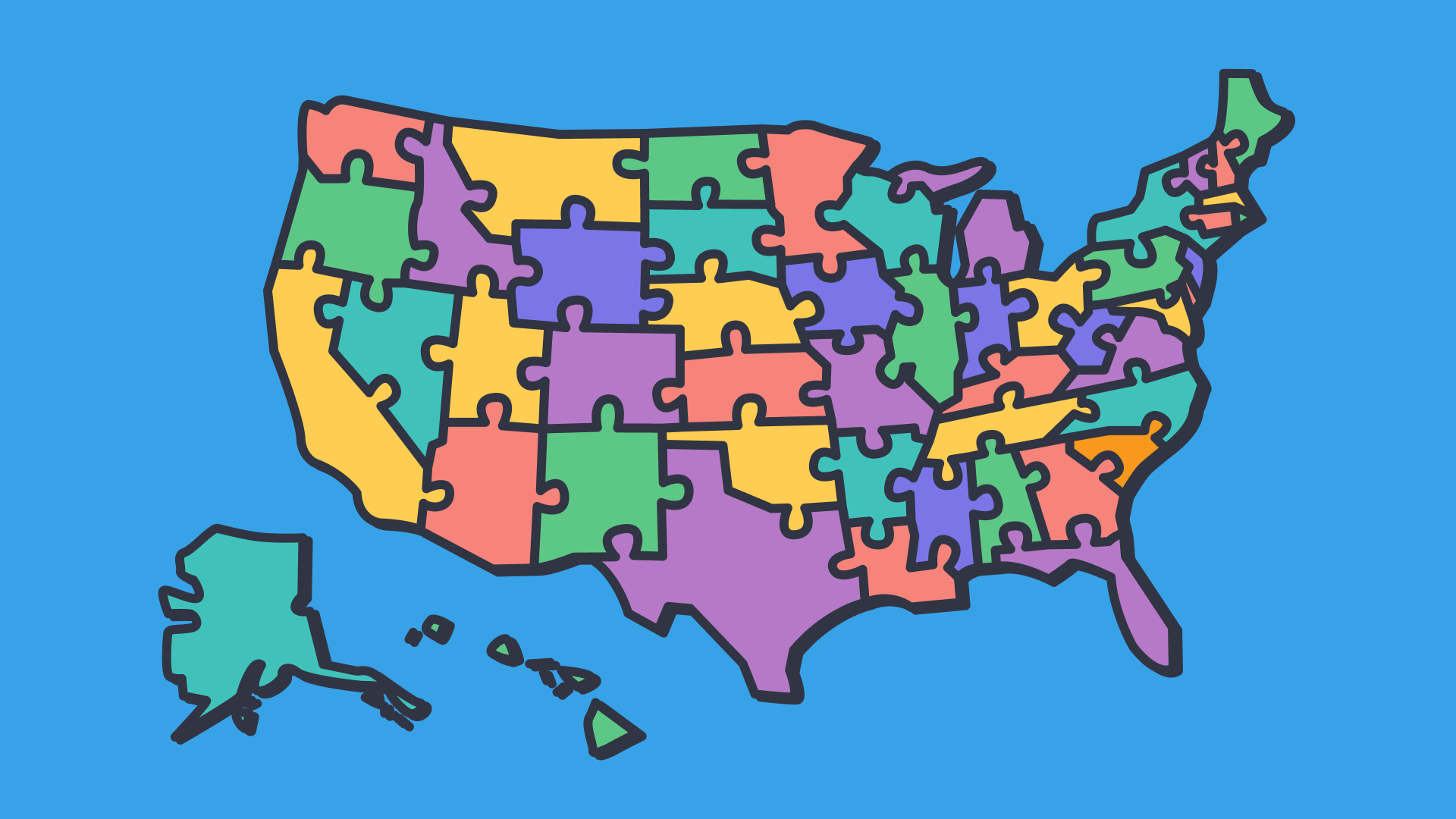
Teaching US geography in the elementary classroom can definitely be challenging. With so many states, cities, capitals, etc to learn about, how can students be expected to retain even a modicum of this information?
That’s easy – make it fun!
Why geography games are effective for learning

Studies have confirmed that using games as a learning tool is an effective strategy for teaching. If using games in the classroom is new to you, here’s a quick intro to get you started.
US geography is an enormous, multifaceted topic, and, although that sounds daunting, what it really means is that there are a ton of opportunities to play around (pun intended) with the content and to infuse other important content into our US geography lessons.
By learning through interactive classroom games and activities, students are able to exercise their critical thinking skills while developing their spatial awareness. US geography games can also help you foster empathy and promote cultural understanding in your classroom. Most games can also easily be differentiated to suit different learning styles.
Another positive? Games are fun. Playing games in a safe, supervised environment ensures that your students are engaged in active learning while taking ownership of their individual learning processes.
Top US geography games for elementary students
Ready to play? Here are some really fun US geography inspired games you can play in your classroom:
1) Pin that state!
Who doesn’t love a game of pin the tail on the donkey? Re-work this classic game to make it US geography based.
Take a large map of the United States and use masking tape to cover up the names of the states. If you don’t have a map that will work you can draw an outline on a large piece of paper or poster board. This map will serve as your “donkey”.
You’ll also need something to act as the tail for pinning. Any type of sticky note will work just fine. Note that we won’t be blindfolding students for this game – it would defeat the purpose!
Individually or in pairs, your students will approach the map and identify a state of your choosing by placing the sticky note in the correct spot. You may wish to have them write out the name of the state on the sticky note.
Once all of the states are labeled, take a step back and see how they did!
- Which states were easy?
- Which was more difficult?
This will help you identify and target areas for improvement.
2) 20 questions
Here’s another well-known game we can adapt for our geography lessons. You, or your students, take turns thinking of a state. The rest of the class will try to identify the correct state by asking geographically relevant questions. For example:
- Is this state a coastal state?
- Was this state one of the original thirteen colonies?
- Is this state below the Mason-Dixon line?
- Does this state use Pacific Standard Time?
- Does this state border another country?
Can your students guess the right state in under 20 questions?
3) Geography bingo
Download and print one of many free bingo templates online, or make your own if you prefer. A state goes in each of the boxes. You may choose to write in the name of the state, or for more of a challenge, just draw the outline of the state.
One by one, call out the name of a state. If your students have that state on their bingo card, they mark it off. First one to get bingo wins!
You can adapt this game to focus more on what you’re studying in class by instead calling out specific attributes of or facts about the state instead. For example, you can ask your students to find a state that was established in 1833, or one that borders a Great Lake.
4) US states jeopardy
Some of my favorite days in school were when our teachers would let us play jeopardy. It’s a great game for any classroom because it’s completely customizable. I’ve had teachers project a pre-made game from a website onto the board or just use flashcards – whatever is accessible to you will work just fine.
Divide your students into two teams and have them take turns choosing a topic. Just like on TV they’ll earn points by answering questions correctly. The more difficult the question, the more points their team will earn!
Here are some suggestions for topics:
- US capitals
- Physical geography
- Cardinal directions
- States by population
- Bodies of water
This is also a great review game to get some practice in before a test!
5) Geography detective
Send your students on a high-stakes mission to track down a person of interest. You can think of this as a lo-fi version of Where in the World is Carmen San Diego?
Provide clues about the geographic location they need to find using landmarks and other notable physical features. You can do this verbally, or up the ante by hiding clues around your classroom.
Play solo or in teams – either way, your students will be super excited to put on their detective hats!
How to integrate geography games into lessons
There are a few things you should keep in mind when you’re planning to integrate games into your geography lessons.
James Paul Gee in his article “Learning and Games” in The Ecology of Games: Connecting Youth, Games, and Learning (The MIT Press, 2008), outlines five conditions that must be met for a game to be considered a useful learning tool:
- The game is structured by specific goals.
- The experiences of players can be interpreted and applied in different contexts, reflecting deeper understanding.
- Players are able to receive immediate feedback.
- Players have the opportunity to apply previous experiences.
- Players are able to learn from other players through reflection upon completion.
It’s important to keep these conditions in mind when planning to use geography activities for kids in your classroom.
There are also a few practical aspects of lesson planning I’d urge you to consider:
- First, make sure you understand the rules of the game! You won’t be able to help your students if they get stuck if you don’t know the game backwards and forwards. If possible, practice playing beforehand and identify anything tricky that might come up in the classroom.
- Second, be sure to identify clear objectives of your lesson and choose games that are compatible with your learning goals. Games should also be age and developmentally appropriate for your students.
- Third, be sure to set aside an appropriate amount of time for play, including time to explain the rules, answer questions, and of course buffer and transition times. You’ll want to leave some wiggle room in your lesson plan to allow for active learning, teachable moments, and problem solving.
- Finally, be sure to set clear expectations for behavior and compliance to rules. Remind your students that games are for fun, and in this case, for learning! So it’s more than okay to make mistakes or not to “win” every time.
Tools and resources for geography games
There are a ton of resources available for accessing, learning about, and playing US geography games. Here are a few of my favorite books, websites, and more:
- American Association of Geographers.
- Balkan, G. (2017). 50 Cities of the U.S.A. Wide Eyed Editions.
- Digital Collections | Collections | Geography and Map Reading Room | Research Centers | Library of Congress.
- Free custom bingo card generator.
- Geoguessr.
- GeoflightUSA.
- Higgins, N. (2014). US Geography through Infographics. Lerner Publishing Group.
- The complete book of maps & geography. Grades 3-6. (2017). Greensboro: Thinking Kids’.
- JeopardyLabs.
- Scoffham, S. (2017). Teaching geography creatively. London New York Routledge.
- Seterra.
- Smithsonian Education – Geographic Resources – North America.
- Statistics & Facts | Statista.
Teaching US geography doesn’t have to be boring, and incorporating games into your classroom is a guaranteed way to ensure your students are engaged with the content.
Share to

Jessica Pastore
briefcase iconMuseum Educator
Jessica Pastore is a museum educator living and working in New York City. Her background is in social studies education and world history. She has taught in both classroom and gallery settings for the past ten years.
Other posts



Want more content like this?
Subscribe for blog updates, monthly video releases, trending topics, and exclusive content delivered straight to your inbox.