
How to make plate tectonics engaging for students
Published on 8 min read

In this guide
- Why plate tectonics matters in the classroom
- 7 activities for teaching plate tectonics
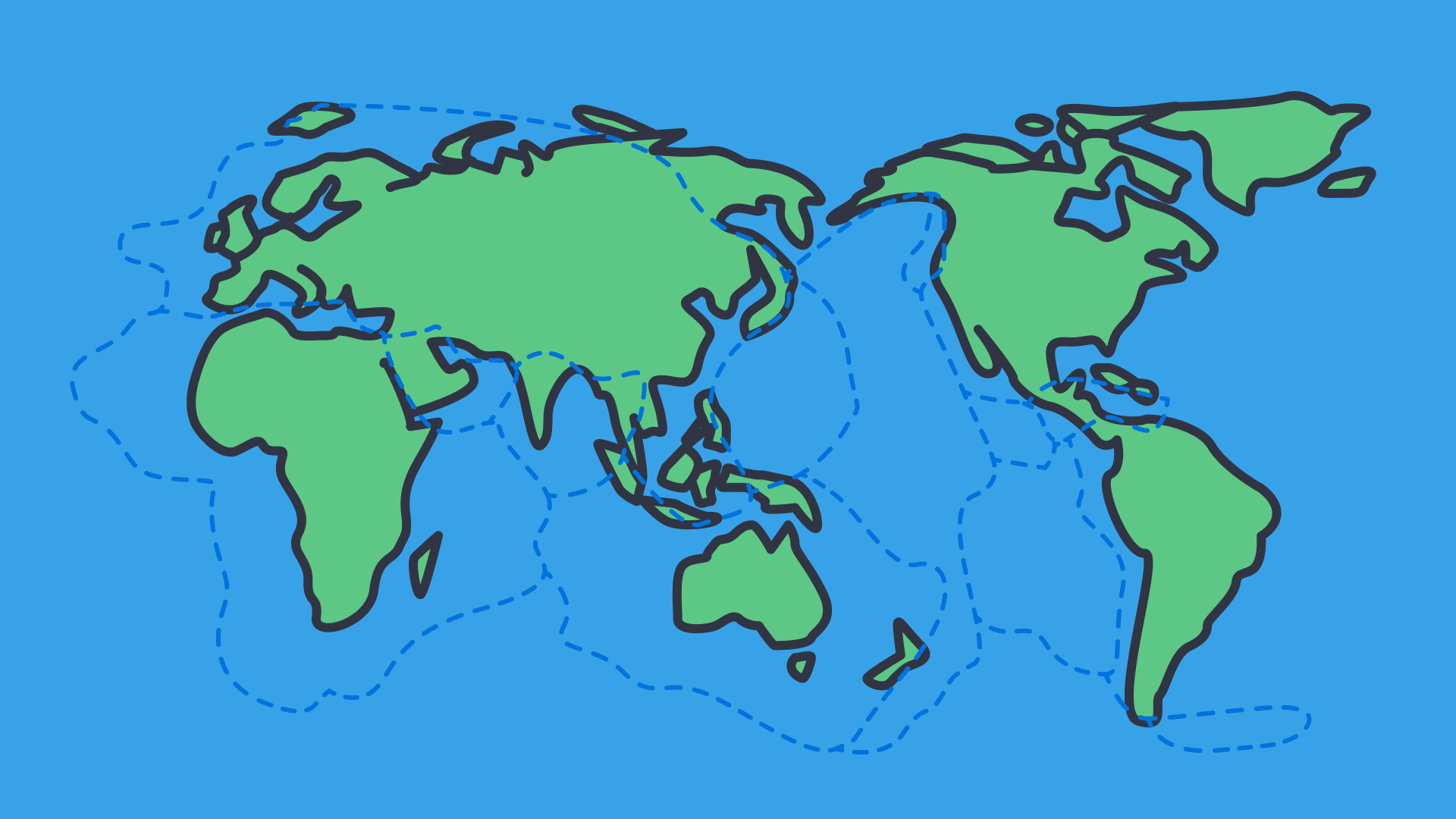
- 1) Map Earth’s tectonic plates and plate boundaries
- 2) Trace the journey from Pangaea to the present
- 3) Model plate boundary interactions
- 4) Investigate volcanoes and the carbon cycle
- 5) Simulate earthquake tracking with real-world data
- 6) Analyze fault lines and predict seismic risk
- 7) Hold a plate tectonics documentary screening and discussion
- Tips for ongoing integration
- Sources
Why plate tectonics matters in the classroom
Plate tectonics is one of those foundational concepts that ties together almost everything in Earth science, from the formation of mountain ranges to the occurrence of earthquakes and volcanic eruptions. It’s the framework that explains why continents look like puzzle pieces, why Iceland sits on a volcanic hotspot, and why California is bracing for the next big quake.
And yet, for many students, plate tectonics feels abstract. They’re learning about processes that unfold over millions of years, deep beneath the ground they walk on. How do you make something so vast and slow-moving feel real and urgent?
The answer, as any experienced science teacher knows, lies in connecting theory to observable phenomena. When students watch footage of tectonic forces reshaping landscapes or track real earthquake data along the San Andreas Fault, the concept shifts from static textbook diagrams to become something more tangible. The seven activities below are designed to do exactly that: pair hands-on classroom work with video resources on plate tectonics that bring Earth’s dynamic processes into focus.
7 activities for teaching plate tectonics
1) Map Earth’s tectonic plates and plate boundaries
Before students explore what tectonic plates do, they need to understand what they are and where they sit. This mapping activity grounds the theory in geography and gives students a visual reference they’ll return to throughout the topic.
Start by screening Tectonics: Our Earth and Its Movements, a short overview that walks through Earth’s internal layers and introduces the concept of moving plates. It’s a strong hook: visual, concise, and packed with context.
Then, have students work through the following:
- Provide each student (or pair) with a blank world map and a list of Earth’s major tectonic plates
- Ask them to sketch plate boundaries, labeling each plate
- Have students color-code boundaries by type, creating a legend on their map
- Once maps are complete, display them side by side and discuss: Where do most earthquakes and volcanoes occur? What patterns emerge along plate boundaries?
This is a great opportunity to reinforce the connection between plate boundaries and geological activity.
2) Trace the journey from Pangaea to the present
The story of how one supercontinent broke apart and drifted into the world map we recognize today is one of the most compelling narratives in science. This activity turns that story into a hands-on investigation.
Use Tectonic Plates and a Supercontinent to introduce the concept of continental drift and the evidence that supports it. The video explores how landmasses were once connected and how plate movement created the continents we know today.
Follow up with these steps:
- Give students printed cutouts of the modern continents (to scale) and ask them to reconstruct Pangaea by fitting the pieces together
- Have them identify at least three types of evidence that support continental drift, including fossil records, matching rock formations, and climate evidence from glacial deposits
- Ask students to create a four-panel timeline showing key stages: Pangaea, the initial breakup, an intermediate stage, and the present-day configuration
- Discuss as a class: If plates are still moving, what might Earth’s continents look like 100 million years from now?
That final question tends to spark some surprisingly creative thinking, and it reinforces the idea that tectonic processes are ongoing.
3) Model plate boundary interactions
Understanding the difference between convergent, divergent, and transform boundaries is essential. This activity gives students a physical model to work with and connects each boundary type to the landforms it produces.
Before the hands-on portion, screen Tectonics: Processes and Landforms, a detailed look at how plate movements create specific geological features. For a shorter companion piece, The Tectonics Plates and Creating Landmasses offers a focused exploration of how plate collisions shape the surface.
Then, set up the activity:
- Provide groups with graham crackers, frosting (representing the asthenosphere), and water
- Have students simulate divergent boundaries by pulling two crackers apart on a frosting-covered plate, observing how material rises to fill the gap
- For convergent boundaries, push one cracker under another (subduction) and push two crackers together head-on (collision), noting how one crumples upward like a mountain range
- For transform boundaries, slide two crackers past each other and observe the friction and jagged edges
- After each simulation, ask students to name a real-world example: the Mid-Atlantic Ridge (divergent), the Himalayas (convergent), and the San Andreas Fault (transform)
Students remember the physical experience long after the vocabulary fades.
4) Investigate volcanoes and the carbon cycle
Volcanoes sit at the intersection of plate tectonics, atmospheric science, and biology, making them an ideal topic for cross-curricular exploration. This activity pushes students beyond the dramatic eruptions and into the deeper science of how tectonic processes regulate Earth’s carbon cycle.
Begin with What Are Volcanoes? from the Crash Course Geography series to establish the basics of volcanic formation. Then follow up with Subduction: Volcanoes and Life, which explores the surprising relationship between subduction zones, volcanic activity, and the conditions that sustain life on Earth.
For a vivid case study, Eyjafjallajökull Volcano provides a quick, engaging look at how a single eruption in Iceland disrupted air travel across Europe, proof that tectonic events have far-reaching consequences.
Have students work through the following:
- Create a diagram representing the carbon cycle, highlighting where volcanic activity fits in (carbon dioxide emissions during eruptions, weathering of volcanic rock absorbing CO2 over time)
- Research one active volcano and present a brief case study covering its tectonic setting, eruption history, and impact on local communities and the environment
- Discuss as a class: How do volcanoes act as both creators and destroyers? What role do they play in making Earth habitable?
This is a strong activity for encouraging students to think systemically, to see volcanoes not just as hazards but as part of a larger cycle that sustains the planet.
5) Simulate earthquake tracking with real-world data
If plate boundary mapping gives students the “where,” earthquake tracking gives them the “how.” This activity introduces the tools and techniques scientists use to monitor seismic activity, with a focus on one of the most studied fault systems in the world.
Screen Waves: Seismic Imaging and Tectonics to give students a thorough grounding in how seismic waves are used to image Earth’s interior and track plate movement. Then use Tracking Earthquakes in San Andreas as a focused case study on how scientists monitor one of America’s most famous fault lines.
Follow up with these steps:
- Using the USGS earthquake data feed (available free online), have students pull up recent earthquake data for the past 30 days
- Ask them to plot at least 15 earthquakes on a world map, recording magnitude, depth, and location for each
- Have students identify patterns: Where are the clusters? Do they align with known plate boundaries? Are there any surprises?
- Finish with a written reflection: Based on the data, which regions face the highest seismic risk, and why?
Working with live data transforms this from a textbook exercise into genuine scientific inquiry. Students start thinking like seismologists, and that shift in perspective is powerful.
6) Analyze fault lines and predict seismic risk
Building on the earthquake tracking activity, this one pushes students into analysis and prediction.
Start with Tracing California’s Fault Lines, which explores how scientists map fault systems across California, and Fault Lines and Predicting Damage, which examines the methods and challenges of predicting where and when damage will occur.
Then, guide students through the activity:
- Provide groups with a map of California (or another seismically active region) showing major fault lines
- Ask each group to select one fault line and research its history: When was the last major earthquake? What was its magnitude? What damage occurred?
- Have groups develop a risk assessment for their chosen fault, considering population density, infrastructure, historical seismic activity, and proximity to other faults
- Each group presents their findings and recommends preparedness measures for communities along their fault line
What makes this activity effective is the real-world stakes. Students aren’t just learning about fault lines. They’re grappling with questions that urban planners, engineers, and emergency managers face every day.
7) Hold a plate tectonics documentary screening and discussion
Sometimes the most impactful teaching tool is a well-chosen video paired with structured discussion. This activity works as a capstone for the unit, pulling together everything students have learned and placing it in a broader context.
Screen The Plate Tectonics Revolution from the Crash Course Geography series. This video traces the history of plate tectonic theory itself, tracing how scientists moved from Alfred Wegener’s controversial hypothesis to the widely accepted framework we use today. It’s a compelling reminder that scientific understanding evolves.
For added depth, pair it with Earthquakes and Water Creating Land, which shows how seismic processes work alongside water to build new landforms.
After the screening, facilitate a structured discussion:
- Why was Wegener’s theory of continental drift initially rejected by the scientific community? What evidence eventually changed minds?
- How does the history of plate tectonic theory reflect the process of science more broadly?
- What questions about Earth’s tectonic activity remain unanswered today?
- If you could study any tectonic feature or event on Earth, what would it be and why?
Ending a topic with the story of how the theory developed reinforces a key lesson: science isn’t a collection of fixed facts. It’s a process of questioning, gathering evidence, and revising understanding, exactly the skills you’re building in your students.
Tips for ongoing integration
Plate tectonics doesn’t need to live in a single unit and then disappear from your curriculum. The concepts connect naturally to topics across Earth science and beyond, so weaving them into your teaching throughout the year keeps the ideas fresh and reinforces deeper understanding.
Here are a few ways to keep tectonic thinking alive in your classroom:
- When an earthquake or volcanic eruption makes the news, pause for a quick discussion: Where did it happen? What type of plate boundary is involved? Was it predictable?
- Connect plate tectonics to other units, such as ocean floor spreading in marine science, mountain formation in ecology, volcanic soils in agricultural science, or the distribution of natural resources in geography
- Encourage students to follow the USGS or a similar monitoring service and bring in interesting data points throughout the semester
- Use ClickView’s plate tectonics topic page as a go-to resource for supplementary videos when related topics surface in class
Earth is always moving beneath our feet. The more your students learn to notice and interpret that movement, the more connected they’ll feel to the science that shapes the world around them.
Sources
- National Research Council. (2012). A Framework for K-12 Science Education: Practices, Crosscutting Concepts, and Core Ideas. Washington, DC: The National Academies Press.
- NGSS Lead States. (2013). Next Generation Science Standards: For States, By States. Washington, DC: The National Academies Press.
- United States Geological Survey. “Earthquake Hazards Program.” USGS. https://earthquake.usgs.gov/
- Oreskes, N. (2003). “Plate Tectonics: An Insider’s History of the Modern Theory of the Earth.” Westview Press.
Share to

Rebecca Langham
briefcase iconCurriculum Specialist
Rebecca Langham is a Curriculum Specialist at ClickView, bringing more than 20 years’ education experience spanning roles such as secondary teacher, school leader, curriculum advisor and published writer.
Other posts



Want more content like this?
Subscribe for blog updates, monthly video releases, trending topics, and exclusive content delivered straight to your inbox.