10 Activities to teach students about 2D shapes
Published on 11 min read

In this guide
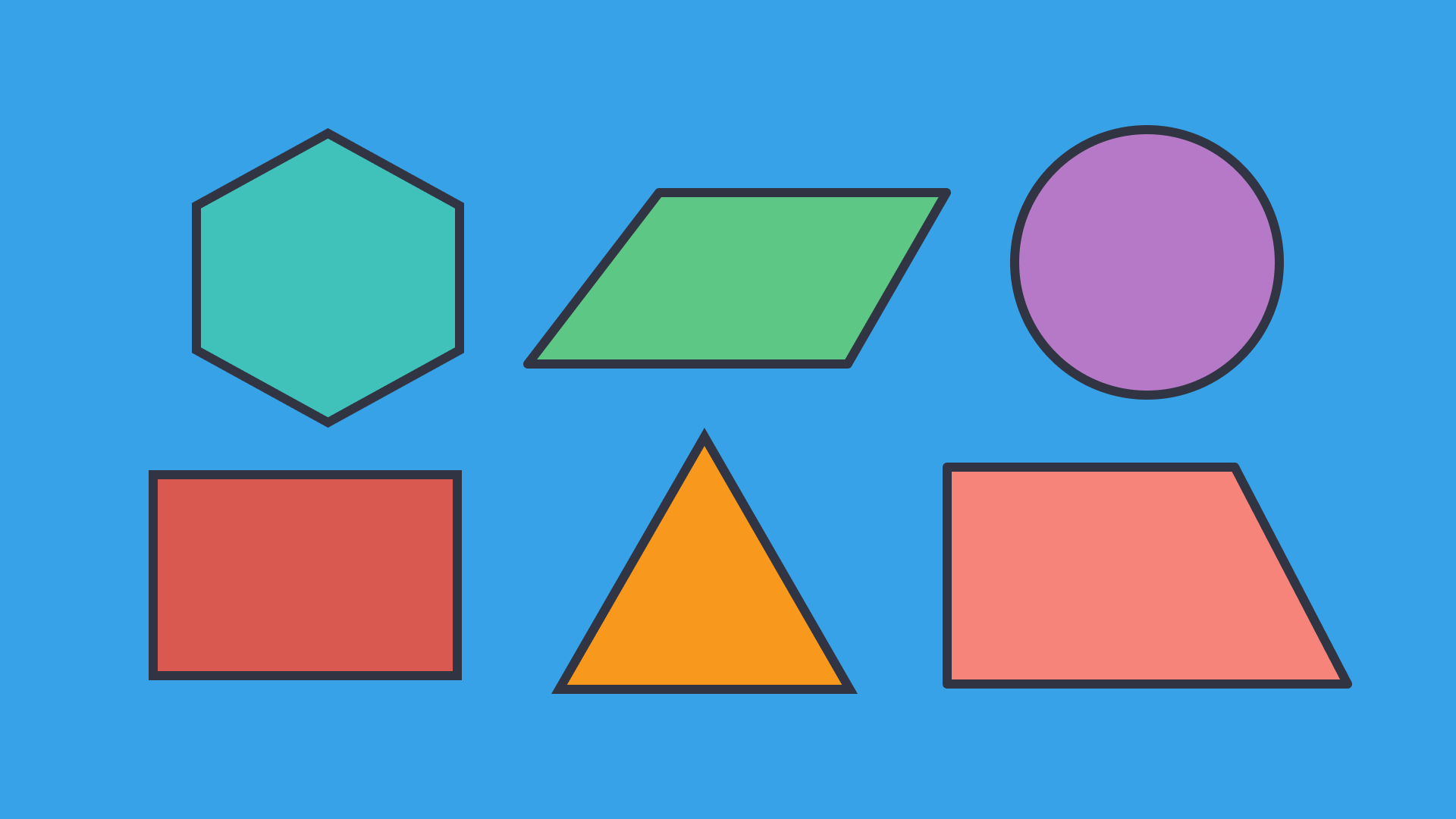
Shapes are everywhere. Your students see them in floor tiles, road signs, sports fields, and building facades every single day. That makes 2D geometry one of the most organic areas of math to teach, because the real world is your best resource.
Whether you’re introducing 2D shapes to a kindergarten class for the first time or helping middle schoolers explore congruence and transformations, these 10 activities give you practical, classroom-ready ideas backed by video resources your students will actually want to watch.
Getting to know 2D shapes
These first four activities work well for elementary students building foundational shape recognition skills. They’re also useful review activities for older students who need a refresher before tackling more complex geometry.
1) Go on a shape hunt
Shapes are hiding in plain sight all around the classroom and beyond. A shape hunt gets students out of their seats and looking at the world through a geometric lens.
Start by showing the Finding Shapes and Patterns in Nature video to spark students’ curiosity about where shapes appear in the real world. Then send them off to find as many 2D shapes as they can, either inside the classroom or outdoors.
Here are a few ways to structure the hunt:
- Give students a checklist of shapes to find (circle, triangle, rectangle, hexagon) and have them sketch or photograph each one
- Challenge students to find more complex shapes like trapezoids, rhombuses, or parallelograms
- Provide shape riddles instead of names, for example: “Find a shape with four sides, but only two of the lines are parallel”
- Have students record their findings and sort them into categories based on the number of sides
This activity is ideal for Grades K through 4.
2) Sort shapes by their features
Once students have a sense of what 2D shapes look like, sorting activities push them to think more critically about what makes shapes different from one another.
Use the What Are Polygons? video as a warm-up, then provide students with a collection of cut-out shapes (or printed shape cards) and ask them to sort the shapes into groups.
There are plenty of ways to vary the sorting criteria:
- By name: group all triangles together, all quadrilaterals together, and so on
- By the number of sides or vertices
- By lines of symmetry
- By angle type, for example: shapes with at least one angle less than 90 degrees
- Regular versus irregular shapes
- Types of triangle or types of quadrilateral
For an added challenge, have students create Venn diagrams that overlap two sorting criteria. Which shapes have four sides and at least one right angle? How do students handle a square that fits into multiple categories?
3) Build shapes with everyday materials
There’s something about physically constructing a shape that helps the concept click. Shape building is engaging for students across grade levels and gives you a natural entry point for discussing properties like side length, angles, and vertices.
Set students the task of using popsicle sticks, pipe cleaners, or straws to build their own shapes. Start with simple shapes like triangles and squares, then challenge students to create pentagons, hexagons, and beyond.
To extend the activity:
- Incorporate protractors and have students aim for regular shapes with equal angles
- Ask students to create a shape artwork using at least five different 2D shapes, then label each one in their drawing (a house with a triangular roof, rectangular door, and square windows, for example)
- Provide challenges like “use three different types of triangles in your design”
- Once shapes are built, have students sort their creations by characteristics like the number of sides or vertices
This activity pairs well with the Triangular Triangles video, which brings personality to different triangle types and makes a great lead-in to a building challenge.
4) Use songs and videos to introduce shape vocabulary
For younger students especially, songs and short-form videos are powerful tools for locking in shape names and features. They’re also a welcome change of pace during a math block.
ClickView offers several videos that work well here:
- 2D Shapes Song (Grades K through 2, three minutes): A catchy introduction to common 2D shapes and their features
- Basic Shapes Song (Grades K through 2, five minutes): Helps students practice naming shapes in everyday objects
- Get Into Shapes (Grades K through 2, three minutes): A musical warm-up that makes shape identification feel like a game
- Describing 2D Shapes (Grades K through 2, five minutes): A short clip covering shape features and where to spot them in the real world
After watching, try a quick “pause and point” quiz: pause a video mid-sentence and ask students to identify the shape on screen, name its properties, or draw it on a whiteboard. It keeps the energy up and checks for understanding at the same time.
For a creative challenge that extends students, have them come with up with their own shape songs in groups, setting their lyrics to a familiar piece of pop music. This could even be an opportunity to have older elementary students collaborate with younger ones.
Exploring shape families up close
These activities focus on specific shape categories and work well for upper elementary through middle school students. They’re designed to build deeper understanding of how shapes are classified and what makes each family unique.
5) Investigate triangles and their types
Triangles are the simplest polygon, but they come in more varieties than most students expect. This makes them a great starting point for teaching classification skills.
Begin with the Triangles video to introduce the basics, then move to Types of Triangles in Euclidean Geometry for a deeper dive. For elementary students, the Classifying Types of Triangles video from Numberock covers the same ideas with a more accessible tone.
Once students have the vocabulary down, try these activities:
- Triangle sorting station: Give students a set of triangle cut-outs and have them classify each one as equilateral, isosceles, or scalene. Then ask them to re-sort by angle: right, acute, or obtuse. Can a triangle be both isosceles and right-angled?
- Triangle scavenger hunt: Challenge students to find or draw real-world examples of each triangle type
- Angle investigation: Have students measure the interior angles of several triangles and discover for themselves that they always add up to 180 degrees
For middle school students, extend into Classifying Triangles, Altitude of a Triangle, and Exterior Angles of a Triangle to connect classification to measurement and proof.
6) Dive into quadrilaterals
Quadrilaterals can trip students up because there are so many subtypes, and the relationships between them aren’t always obvious. Is a square also a rectangle? Is a rectangle also a parallelogram? These are the kinds of questions that spark mathematical discussion.
Start with the Types of Quadrilaterals video from Professor Dave Explains, then follow up with the Quadrilaterals video from Basic Geometrical Ideas for additional examples and visuals.
For elementary students, the The Quadrilateral Song is a memorable way to introduce the different types, and What Is a Quadrilateral? (Definition and Examples) breaks down the basics clearly.
Here’s how to turn this into a hands-on lesson:
- Quadrilateral family tree: Have students create a visual diagram showing how squares, rectangles, parallelograms, rhombuses, trapezoids, and kites relate to one another. Which shapes are special cases of other shapes?
- Property cards: Write the properties of each quadrilateral on separate cards (for example: “all sides equal,” “opposite sides parallel,” “four right angles”). Students match each property set to the correct shape name
- Parallel lines investigation: Use the Parallel Lines video as a springboard, then have students identify which quadrilaterals contain parallel sides and how many pairs
7) Explore circles and their parts
Circles are unique among 2D shapes: no sides, no vertices, just one continuous curve. That makes them fascinating for students, but also a little tricky to define and measure.
The Circles video from Real World Math is a strong introduction that connects circle properties to everyday contexts. For a more detailed look at terminology, follow up with Circles: Radius, Diameter, Chords, Circumference, and Sectors. For younger students, What Are the Parts of a Circle? keeps things clear and concise.
To bring circle concepts to life:
- Circle measuring station: Provide students with circular objects of different sizes (lids, plates, hoops) along with string and rulers. Have them measure the radius, diameter, and circumference of each object and record their findings in a table. Do they notice a relationship between diameter and circumference?
- Label the circle: Give students a blank circle diagram and ask them to label the radius, diameter, circumference, and center. Then challenge them to add a chord and a sector
- Circles versus ovals: Discuss how ovals differ from circles (the distance from the center to the edge is not equal at all points). Have students test objects with string to determine which are true circles and which are ovals
Applying 2D shape knowledge
These final three activities help students apply what they’ve learned in creative, cross-curricular, and real-world contexts. They’re suitable for upper elementary and middle school students.
8) Calculate perimeter and area in real-world contexts
Perimeter and area give students a reason to care about the properties they’ve been learning. After all, knowing that a rectangle has four sides and four right angles becomes much more meaningful when you’re using those properties to figure out how much fencing a garden needs.
For perimeter, start with the What Is Perimeter? video or the shorter What Is the Perimeter? clip. The Calculating the Perimeter of Rectangles video walks through the process step by step.
For area at the middle school level, ClickView’s Area and Perimeter series covers specific shape types: Area of a Triangle, Area of a Rectangle, Area of a Parallelogram, and Area of a Trapezoid.
Try these real-world tasks:
- Design a room: Give students graph paper and have them design a room using specific shapes. They then calculate the perimeter (for baseboard) and area (for flooring)
- Playground planner: Students design a playground with different shaped zones (a rectangular sandbox, a triangular garden bed, a circular splash pad) and calculate the area of each zone
- Fencing challenge: Present students with a fixed amount of fencing and ask them to determine which shape arrangement encloses the largest area
9) Create tessellation artwork
Tessellation is where math and art meet, and it’s a concept that genuinely excites students once they see it in action. A tessellation is a pattern of shapes that fit together with no gaps and no overlaps, and certain 2D shapes tessellate while others don’t.
Start with the What Is Tessellation? video to introduce the concept, then let students explore for themselves.
Here’s how to structure the activity:
- Begin by asking students to predict which shapes tessellate. Squares? Triangles? Hexagons? Circles? Why or why not?
- Provide shape tiles or cut-outs and let students test their predictions by arranging shapes on a flat surface
- Once students understand the basic rules, have them create their own tessellation artwork using one or more shape types. Colored pencils, markers, or paint bring the designs to life
- Display the finished tessellations around the classroom and have students explain the geometry behind their patterns
This activity connects naturally to discussions about polygons and angle sums. Why do equilateral triangles, squares, and regular hexagons tessellate, but regular pentagons don’t? The answer lies in interior angles, and it’s a satisfying “aha” moment for students.
10) Connect shapes to real-world careers
One of the most common questions in any class is “When am I ever going to use this?” Shapes give you a ready-made answer.
The A Day in the Life of a Construction Worker video from the Careers with Math series shows students how shapes and spatial reasoning play a role in everyday construction work. It’s a great conversation starter about where geometry shows up beyond the classroom.
To extend this into a broader activity:
- Career research project: Have students choose a career (architect, graphic designer, engineer, quilter, landscape designer) and research how 2D shapes are used in that profession. Students present their findings to the class
- Shape spotting challenge: Assign students a specific real-world context (a building, a sports field, a piece of art) and have them identify and classify every 2D shape they find
- Design brief: Give students a real-world design challenge, such as creating a tile pattern for a bathroom floor or a layout for a community garden, and have them apply their shape knowledge to solve it
When students see that geometry is part of building bridges, designing logos, and planning cities, the math stops feeling abstract and starts feeling relevant.
Tips for ongoing 2D shape integration
Teaching 2D shapes doesn’t have to be limited to a single unit. Here are a few ways to keep shape thinking alive throughout the year:
- Math warm-ups: Start each lesson with a quick “shape of the day” where students identify a shape, name its properties, and find an example in the room
- Cross-curricular connections: Link shapes to art projects, science observations (crystal structures, leaf shapes), and even social studies (flags, maps)
- Video check-ins: Revisit short ClickView videos like 2D Shapes or An Intro to Polygons as refreshers before introducing related topics like 3D shapes, angles, or perimeter
- Student-led reviews: Have students teach a 2D shape concept to a partner or small group. If they can explain it clearly, they truly understand it
2D shapes are one of those rare math topics where the learning never really stops. The kindergartner identifying circles during snack time and the 8th grader calculating the area of a parallelogram are both building the same core spatial reasoning skills. With the right mix of hands-on activities, engaging videos, and real-world connections, you’ll help your students see geometry not as something that lives only on a worksheet, but as something woven into the world around them.
Share to

Rebecca Langham
briefcase iconCurriculum Specialist
Rebecca Langham is a Curriculum Specialist at ClickView, bringing more than 20 years’ education experience spanning roles such as secondary teacher, school leader, curriculum advisor and published writer.
Other posts


Want more content like this?
Subscribe for blog updates, monthly video releases, trending topics, and exclusive content delivered straight to your inbox.