
What is fake news and how it affects students
Published on 10 min read

In this guide
In our digitally connected world, students are constantly bombarded with information from social media, news, television, and online video platforms. While the internet has increased the accessibility to information, it has also led to the proliferation of misinformation and disinformation.
Understanding what fake news is, how it affects young people, and what we can do about it is now a critical area of focus schools need to address in order to develop critical thinkers and responsible digital citizens.
Defining fake news and how it spreads
Fake news refers to false or misleading information presented as news, often with the goal to generate clickbait, manipulate public opinion, generate revenue, or gain power.
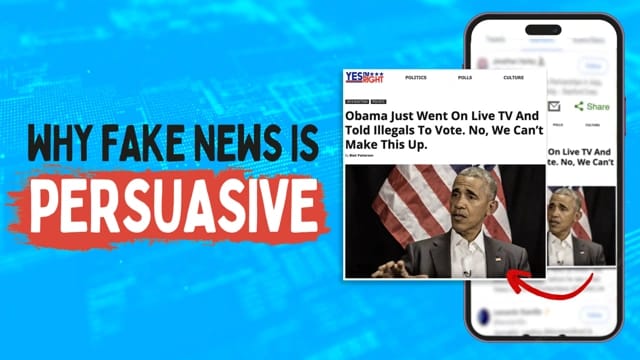

There are two key types of fake news:
1) Misinformation
False information shared without harmful intent. These are typically instances of incorrect information being shared irresponsibly.
Examples of misinformation include rumours and incorrect reporting.


2) Disinformation
False content shared deliberately to mislead or manipulate. This type of content is much more malicious in nature with specific goals.
Examples include smear campaigns and conspiracy theories.
Fake news is more likely to spread online, specifically with social media, so as these technologies expand so does the prevalence of misinformation and disinformation. As more and more of us get their news from social media, sorting fact from fiction becomes more challenging.
Algorithms that prioritise sensationalism help fuel the spread of misinformation. Modern communication technology tools allow individuals to share fake news throughout their network almost instantaneously. Nearly half of news sharers admit to sharing inaccurate or false information as a way to express their feelings (True or False? How Much Is Fake News Influencing Our Lives?, n.d.).
Spotting fake news is also becoming increasingly difficult as the ways to create it become more advanced. Deepfakes and professional-looking news clips can easily mimic the format of legitimate journalism. Creators of fake news also prey on confirmation bias to help spread ideas that people are more likely to believe.
There are incredibly powerful economic factors behind misinformation and disinformation so it is clear that it is not something that will disappear any time soon. As long as people can profit from peddling false information, the practice will continue.


The impact of misinformation on student beliefs and behaviour
Fake news can have a real impact on how students view the world. They have grown up in the world of social media and have become accustomed to consuming information that is curated specifically for them through complex algorithms.
If you have never asked your students where they get their news, give it a try and you will feel a generational divide. I include lessons on news literacy and conspiracy theories at the beginning of the year in my U.S. History classes and like to start by having students share their go to source for news.
I cannot remember the last time a student mentioned TV news or a newspaper. The most popular answers in recent years are Google and TikTok. This is a massive shift in how people get information and should create a sense of urgency to teach media literacy in our classes.
This new media landscape is impacting society as a whole but can have an even larger influence on students who are just beginning to develop their worldviews and personal perspectives. Adolescents may be particularly vulnerable due to their stage of cognitive development, where critical thinking skills and scepticism are not fully developed.
Some key effects of fake news on students include:
Developing perspectives based on falsehoods
- Students may adopt inaccurate views about politics, science, and social issues. These beliefs can form long-lasting biases that make it difficult to comprehend or accept new and conflicting information.
Lack of trust in institutions
- When students are constantly exposed to negative content and accusations about fundamental pillars in society, whether that be individuals or organisations, it is hard to have faith in the overall system of society.
Increased anxiety and confusion
- When you hear so much conflicting information it begins to erode your ability to believe anything. Students can develop a sense of apathy or cynicism that leads to disengagement because they do not feel confident in the information they are exposed to on a regular basis.
Decision making
- Misinformation can lead to harmful choices and actions. Students may feel confident in their actions because a source supports their perspective even if that information is not based on factual evidence.
Early exposure to fake news can create a long and lasting lens that distorts the way students interpret both personal and global events.

Teaching students how to evaluate the credibility of sources
Combating fake news requires sustained effort and a variety of tools. Today, we need to be able to critically assess information across a variety of platforms. Explicit instructions and regular practice are required to develop these vital skills. Try to teach the following strategies to improve students’ ability to evaluate information:

Check sources
- Teach students to identify the original source of an article or claim. Help them develop the habit of verifying the credibility of a source before accepting that information as fact or sharing it with others.
Cross-referencing
- Encourage students to search for multiple sources reporting the same information. Can they find independent and separate organisations reporting on the same information?
Fact-checking tools
- There are a number of online tools you can share with students that they can use when trying to verify information. Snopes, FactCheck, and PolitiFact are a few great places to start.
Lateral reading
- Instead of reading vertically down one article, encourage students to open new tabs and explore what other sites say about the same topic.
Building these habits prevents students from automatically accepting information as fact and adds some additional guardrails that helps them act as more responsible consumers of content. These techniques and tools can be utilised regardless of the source or technology so they are likely to stand the test of time as communication methods evolve.
Practical classroom activities for exploring fake news
The most effective media literacy lessons that help students authentically explore and combat the impact of fake news are interactive and relevant. Students have experience with this topic so it is important to lean into that as a starting point.


Here are a few quick, engaging activities to integrate into your classroom instruction:
1) Photo detectives
Visual information and visual creation is hugely emphasised in my lessons. I have found that students feel that visual information is more reliable than written or spoken content. This creates a great opportunity to show students that imagery is just as susceptible to manipulation as verbal information.
- Kick off the activity by showing students Evaluating Photos and Videos. Spend time discussing the techniques and strategies covered in the video.
- Project or hand out a fake news image for students to evaluate. Ask them to answer the following questions:
- Is there a caption or source for the image?
- Can you find this image online anywhere?
- Does it look like any parts of the image are manipulated or distorted?
- Has the image been cropped or is there missing information?
- What makes you question the authenticity or reliability of this image?
- Have students pair up and share their responses with each other.
- As a class, discuss which steps or details were the most significant in identifying this image as fake or misleading.
For more resources and example photographs, check out the lesson ideas available at the Digital Inquiry Group website.
2) Hoaxes throughout history
Fake news can seem like a recent phenomenon because of its prevalence. This activity helps students understand that it is not new and is not going away any time soon.
- Get students into groups and assign them a specific historical hoax.
- Asks students to answer the following questions:
- Why was the fake news created?
- Who benefitted from the news?
- Who lost or was harmed from the news?
- Each group should create a short presentation of their hoax and their answers.
- Allow each group to present their findings and then discuss as a class the similarities between all of the examples.
- Conclude by determining what major lessons or takeaways can be found by examining historical hoaxes.
What I really love about this activity is that it showcases how the motivations and strategies of people who create fake news have remained fairly consistent throughout history even though the technology has changed. This helps give students confidence they can spot fake news, even as digital tools become more advanced.
3) Creating fake news
A fun (and sometimes worrisome) activity to help students get better at identifying fake news is giving them the opportunity to create it themselves.
Don’t be shocked if some of the results are really convincing!
- Start by showing the class How is Fake News Created?
- Next, have them form small groups and ask them to identify a modern day topic to create a fake story about (government, celebrity, science, weather, etc.).
- Have each group write a short and provocative headline for their story that instantly grabs viewers’ attention.
- Then, each group should write a short blurb that explains the story in clear, concise, and persuasive language.
- Finally, have each group find or create an image that could be used to accompany their story. If possible, allow them to use image editing software or AI image generators.
- Allow each group time to present their work and have the class vote on the most convincing one.
It may seem counterproductive at first to use this activity but I guarantee it will get students excited about this topic and help them truly absorb the strategies used to trick them into believing inaccurate information.

Encouraging lifelong media literacy and critical thinking
Advanced digital literacy skills are a powerful protection against believing fake news. It is therefore critical that we empower our students with the ability to confront misinformation throughout their lives (Beauvais, 2022). Media literacy and critical thinking skills need to be fundamental elements of a student’s entire journey through school, no matter the age or subject.
Students need help developing the ability to navigate a constantly evolving media machine. Emphasizing media literacy in the classroom helps promote the critical thinking skills students need to become strategic consumers of information and ethical content creators themselves.
No matter how old we are, we can continuously develop skills and techniques for improving our media literacy so we are less susceptible to the negative consequences associated with fake news. It is a never ending process because the technology and tactics used in this information continue to evolve so it is important to establish a strong foundation for students to continue to use even after they finish their formal education.
Try to include the following elements in your instruction to help students become more aware of how the consume and interpret information:
Understanding the media
There are so many different types of media today and different channels are associated with both advantages and disadvantages. If students can recognise these differences they can be more critical of the intentions of differing sources.
Recognising bias
It is everywhere and can be intentional or unintentional. Either way, bias affects the way people interpret the world and make sense out of events. being able to identify it and assess the agenda behind the source allows individuals to be more critical of what they are consuming.
Digital citizenship
We all play a role in fake news, one way or another. If students can begin to understand how they can influence the prevalence and impact of fake news then they will be better equipped to behave as responsible digital citizens that promote honesty and integrity.
We live in a world experiencing exponential change in so many ways. It can feel overwhelming and even helpless at times so it is important that students believe they have a level of control even when the forces are stacked against them.
Be sure to clarify that fake news will always be a part of society but they have tools and techniques that can diminish its influence. Freedom and democracy rely on open communication so citizens must embrace their role in ensuring that truth prevails in the end.
References
- Believe Fake News Is Sowing Confusion. Pew Research Center. Retrieved May 20, 2025, from https://www.pewresearch.org/journalism/2016/12/15/many-americans-believe-fake-news-is-sowing-confusion/
- Beauvais, C. (2022, March 4). Fake news: Why do we believe it? PubMed Central. Retrieved May 19, 2025, from https://pmc.ncbi.nlm.nih.gov/articles/PMC9548403/
- True or False? How much is fake news influencing our lives? (n.d.). University of Derby. Retrieved May 19, 2025, from https://www.derby.ac.uk/magazine/issue-12/influence-of-fake-news/
Share to

Nick Schwab
briefcase iconLearning Experience Designer
Nick combines his background in psychology, education and design to create physical and digital experiences that empower, engage, and excite learners. His passion lies in constantly developing new learning pathways for students that challenge the status quo in education.
Other posts



Want more content like this?
Subscribe for blog updates, monthly video releases, trending topics, and exclusive content delivered straight to your inbox.