
How to give formative feedback
Published on 5 min read
In this guide
Feedback gives you and your students information about performance relative to learning goals. Giving specific advice and feedback to students helps them improve their efforts towards these goals. This works by redirecting or refocusing a student’s actions, so their efforts are more aligned with achieving a particular learning goal.
Key features of useful feedback
Teachers and peers can provide feedback in a variety of ways:
- Formal
- Informal
- Oral
- Written
- Formative (assessment for learning)
- Summative (assessment of learning)
- Questioning is also feedback on teaching practice which is useful for professional development.
Useful feedback needs to be precise, timely, specific, accurate and actionable. Feedback is most helpful when it comes from a variety of audiences and should be structured to support further learning. Feedback may occur at various points in a learning sequence to keep students on track, encouraging them to achieve their learning goals.
Benefits of formative feedback
Student motivation
If students have a clear understanding of their place on a learning journey, they are often more motivated to achieve. By gathering formative assessment data when beginning a new topic or unit, you and the student can clearly see any gaps in their current learning. Importantly, formative feedback also helps students to acknowledge what they do already know or have mastery of.
Professional growth
Feedback has two-way benefits. While students benefit from feedback, teachers can also learn about how their teaching methods and practices influence student learning. This feedback can come from students or their own peers. When teachers take this feedback on board and use it to inform their professional practice, they can have a more significant impact on student learning.
Providing feedback in the classroom
Positive feedback can be very powerful, especially when it’s clear and specific. Feedback should provide detail about why a student achieved something, acknowledge an improvement or offer concrete advice about how to improve. Feedback is more meaningful for students when given sparingly.
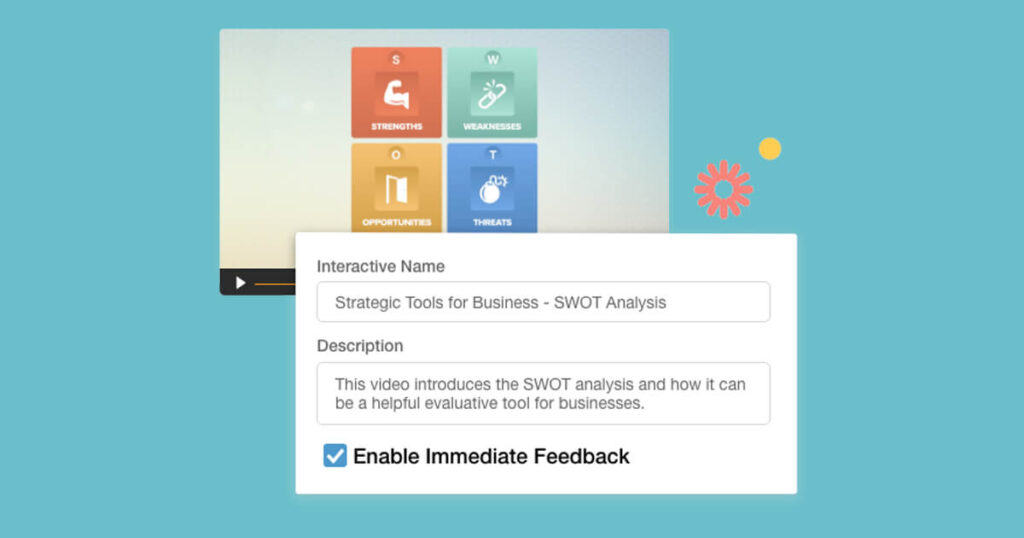
ClickView can help you offer feedback to your students. Interactive videos can be used to give instant formative feedback on a particular topic. You can also choose to provide the feedback at a later time.
4 Ways ClickView can help you with effective feedback
- Provide lasting feedback
You can access the screen capture feature while talking through feedback on student work, add it to your Workspace and send it back to the students. Students then can review or revisit this feedback at a later date. - Easily annotate performance work
Use the interactive video feature to annotate videos of student performance in subject areas such as Drama, Dance and English for oral presentations, group performance pieces, or play readings. - Give valuable performance feedback
Use ClickView for micro-teaching or peer assessment. - Develop your skills
Record your lessons for mentoring or coaching from a supervisor for your own professional development. You could do this over time to track progress or to work on developing a particular skill.
4 Teacher tips for formative feedback
- More on oral feedback
Oral feedback is most commonly used during a lesson to give in-the-moment feedback. Giving this kind of timely feedback can be really effective, as it occurs in the teachable moment, rather than at a later time. Oral feedback can also be useful in encouraging students to think about their learning. You might find yourself giving more feedback this way when you’re teaching remotely, as it works well in a virtual environment. Explore downloadable educational resources for classroom ideas. - Using written feedback
Effective written feedback can be very useful. It needs to be timely and delivered in a way that students can understand and action. The best kinds of written feedback identify where a student has met expectations or learning intentions, plus some areas where they can still improve. Be sure to take the time to set meaningful goals at the beginning of the term or unit to be able to track progress effectively and provide tangible feedback. - Delivering formal feedback
When preparing to deliver formal feedback to students, it’s important to properly prepare. Whether you’re teaching secondary History or primary PSHE, make sure you look at the work before you meet with the student and provide them with some written feedback to take away. Focus on just a few items in your discussion and give the student time to respond. Check out our teaching strategies resources for even more ideas. - Using informal feedback
Informal check-ins are a great way to monitor student progress during learning. They can be used to see how students are managing with a task. The process of checking in is vital to make sure students are on track. Check-ins are also a valuable opportunity to quickly steer a student in a different direction to maximise their learning success. Interactive videos are an easy way to gather meaningful data on progress throughout a topic or unit of work.
Achieve fantastic learning outcomes with effective teaching strategies
Subscribing to ClickView provides full access to 1000s of curriculum-aligned videos, including all supporting educational resources. You also have unlimited access to our dedicated training channel and our customer success team, to make sure you’re getting the most out of ClickView. This means the ability to watch video tutorials on topics such as interactive videos or Library Editor whenever you need to, wherever you are, on any device. We’re here to give you advice on using teaching strategies, such as providing useful feedback, to maximise student learning outcomes.
Share to

Tara Walsh
briefcase iconHead of Education
A qualified teacher and human resources professional, Tara has had an extensive career as a teacher and leader in K-12, and in learning and development.
Other posts



Want more content like this?
Subscribe for blog updates, monthly video releases, trending topics, and exclusive content delivered straight to your inbox.