
Strategies to increase classroom discussions
Published on 11 min read


In this guide
Classroom discussions are a vital component of the educational experience. It allows students to have a voice in their learning and ensures that multiple perspectives are heard.
Discussions also allow for students to take more ownership over their learning environment by steering the direction of the conversations as necessary and posing questions that might not be a formal part of your lesson plan.
Effective and authentic discussions do not always happen naturally. They need planning, support, and strategies to ensure that all voices are heard and meaningful lessons are learned. When this happens, students develop a deeper understanding of the topics that are being explored as well as better communication skills.
The importance of effective classroom discussions
Classroom discussions foster active learning, where students are not just passively receiving information but engaging with it, challenging it, and making it their own.
Effective discussions also improve student agency. When students participate in decision making and explore open ended questions, they gain confidence and a sense of ownership over their own learning.
Meaningful classroom discussions are a powerful way to build a sense of community among learners. Sharing ideas and hearing the thoughts of others creates deeper relationships and more empathy.
Research shows that classroom discussions are correlated with the development of critical thinking, increased student motivation, improved communication skills, and higher grades (Learning Through Discussion, 2021).
Classroom discussions help learning become more of a social event rather than an individual process. Maximising and utilising the collective brain power of the entire group becomes a major advantage over isolated environments where growth often tries to occur in a vacuum.
Techniques to encourage student participation
I love classroom discussions and have considered them one of my main strategies as a teacher throughout my career. I am confident leading discussions and feel comfortable improvising to match the rhythm of my students.
My ego took a major hit last year when I had two separate classes that made classroom discussions feel painful for the first time in my career. It was a subject I have taught for years but I could never quite get the same energy in the room as I had in years prior.
This humbling experience made me develop some new tips and tricks to pull out for groups that need a bit more help participating.
Try some of the ones below when you run into a group that seems hesitant to get involved:
1) Talkers and listeners
One of the difficult things about classroom discussions is that you want everyone to participate but also be respectful of the personalities of each learner. This activity from Creative Acts for Curious People embraces individuality while encouraging participation.
- Ask students to separate themselves into two groups- talkers and listeners.
- Tell them to decide which group to join based on how they view themselves in most conversations.
- Give each group 10 minutes to share what makes them a talker or listener.
- Group members should look for similarities or insights about what describes their group the best.
- Then, ask each group to come up with 3 questions they want to ask the other group to better understand what it is like to be a talker or listener.
- Arrange the groups in two lines, facing each other. I think it works better when students are standing but they can be seated, if needed.
- Have each group take turns asking the other group the questions they came up with and encourage multiple people from each group to respond.
- As a class, have volunteers share the biggest takeaway they learned by hearing comments from either their own group members or the other group.
This is a quick and easy activity to set up. It works great at the beginning of the year or any time you notice classroom discussions getting a little stale. I love how it highlights the strengths of both groups so students understand that both skills are necessary for respectful dialogue.
2) Small group, big group
It can be intimidating for students to share their thoughts with the entire class without having enough time to process and a chance to test out what they want to say. This strategy gives students time to formulate responses and share them in smaller groups before participating in a whole class environment.
- Share the discussion questions or topic with the class and have students get into pairs or small groups.
- Give groups time to discuss their thoughts with each other and ask clarifying questions.
- Then, ask small groups to share their conversations with the rest of the class. It can be helpful to ask students to share the most interesting idea they heard from their group.
- Talking about another person’s perspective can be less intimidating than expressing your own at the start.
- Consider alternating in and out of the group size settings throughout the discussion when you notice either low participation or the opposite.
Sharing in small groups can increase engagement since students do not need to wait to be called on.
Discussion Diamonds and Think, Pair, Share are a couple of other different formats that you can use to structure this strategy.
Using either of these techniques will help you overcome the difficulty of getting a class discussion going since the energy and ideas are being generated from everyone, right from the start.

3) Blended discussions
One of the most remarkable results of the pandemic and the abrupt switch to distance learning was seeing how this new environment changed student participation. I was amazed by how many of my ‘quiet’ students became the biggest contributors in an online format. Just because schools are back in person does not mean this strategy needs to go away.
- Pose a question in an online discussion using a learning management system or Google Doc either as homework or at the beginning of class.
- Ask each student to contribute and then respond to a number of their classmates.
- Then, kick off the full class discussion by having students volunteer to share the most interesting dialogue they saw in the online format.
This lets students start the verbal conversation without putting the pressure of having a personal perspective to share.
This concept is a great way to combine the power of online and in person communication. It allows for students to engage in a manner that suits their personality the best.
Check out How to Plan and Facilitate Discussions in Online Classes for more tips on how to maximise technology for more meaningful discussions.
For ideas of how to expand your discussions beyond your classroom walls, take a look at Critical Communication.
4) Silent conversations
When we think of discussions our minds usually envision verbal communication. Expanding the definition of classroom discussions can increase accessibility and engagement.
This activity uses a fun twist to highlight the strengths of students who may not be interested in verbalising their thoughts with the whole class.
- Set up 4-5 open ended questions on large sheets of paper around the room (or use whiteboards, if available).
- Explain to students that they will be engaging in a silent conversation without any speaking.
- Make sure each student has a writing utensil and puts their name next to their contributions.
- Give students 15-20 minutes rotating through each question. They should be addressing both the question and any other responses that are on the paper from other students.
- Wrap up the activity by asking students to reflect on how the silent conversation affected their thoughts, opinions, and behaviors compared to a typical discussion.
This strategy can easily be adapted to encourage more visual learning. Instead of writing their responses, students can draw an image that represents their thoughts or opinions. It is really fun to see students remixing the imagery of their classmates to modify its meaning.
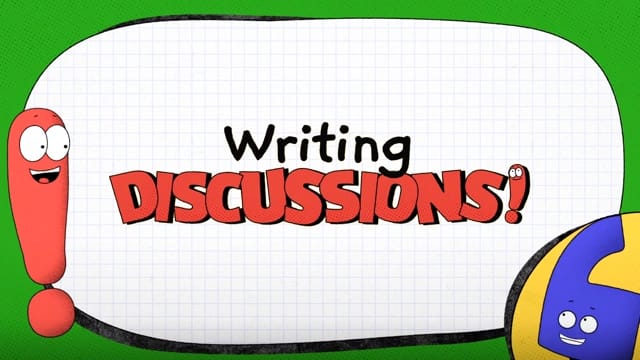
This strategy pairs really well with Writing Discussions! if you are looking for an activity to help students learn how to write this type of text.
5) Yes, and…
So probably my least favorite part of being a teacher is how often I hear the word “no” when proposing new ideas for our school. It is discouraging and can reduce motivation to make an impact. To have meaningful classroom discussions, we need to ensure that a culture of “yes, and” replaces “no, because.”
- Present a topic or scenario for the class to consider and challenge them to come up with the most interesting possibilities.
- Inform the class that each student must start their response by saying “Yes, and…” as a way to build off the ideas shared by the person who spoke before them.
- Emphasise that their opening statement must meaningfully connect to the previous opinion. This will improve student listening skills as well as make students feel more validated for their contributions.
- Continue for as long as students are able to add meaningful contributions.
When you are finished, ask students to reflect on how this simple change impacted the dynamic of the discussion.
This can be a tricky concept for students to adopt so I recommend starting with a weird and funky topic. When all ideas are kind of crazy it is much easier for students to open their minds to new possibilities.
Once they get a hang of the process, these habits can be implemented into more serious conversations.

How to structure discussions for deeper learning
Classroom discussions are a fun way to get everyone involved and reverse the concept that the teacher is the sole provider of knowledge. Discussions must however be intentionally designed and managed in order to allow for deeper learning.
Deeper learning occurs when students are encouraged to analyze, synthesize, and evaluate. The following suggestions will help ensure your discussions push well past basic recall:
Use discussion protocols
Providing clear expectations and a consistent format increases the flow of discussions and makes sure that the topic is the primary focus rather than the process.
Socratic seminars, the Fishbowl strategy, and Philosophical chairs are a few great starting points.
Open ended questions
Stay away from simple questions that can be answered in one word or have obvious answers. The Right Question Institute has numerous resources to help cultivate curiosity through meaningful discussions that encourage active civic participation.
Asking Deep Questions will help students learn how vital the right questions are when it comes to learning.
Warm up routine
It can be tough to jump straight into a confusing or controversial topic so sometimes it is hard to get those first few volunteers speaking to get the conversation going.
Start off with simple questions that do not require extensive subject matter knowledge to answer.
This could be as simple as including activities like drawing or finding partners with similar ideas.
Model active listening
A discussion where everyone talks but no one truly listens is not likely to lead to deeper learning. The more you can use active listening as you facilitate the discussion, the more likely other students will begin to adopt the same behaviour. Not only will this strengthen learning but it will also build trust among members of the class.
Want to take this further? Facilitating Conversations is a wonderful resource for teachers looking for more ideas to improve classroom discussion.

Overcoming common challenges in classroom discussions
Anyone who has ever seen a teacher lead a meaningful and engaging classroom discussion with their class knows that it is both an art and a science. As a teacher, you probably have personal experience with a discussion going great only to see it fall flat with the next group of students you try it with.
Understanding why a discussion did not work is an important part of the learning process as a teacher so that we can get better at identifying problems in real time and making adjustments on the fly.
Here are some common challenges you may run into and ways to address them:
Silent or disengaged students
Use anonymous online tools, like Padlet, or have them respond in writing during the discussion.
Sometimes students just need a nudge or a way to feel confident about their thoughts before feeling comfortable participating in a large group setting.
Dominant voices
This is the ultimate love/hate scenario as a teacher. We appreciate those students that are always willing to participate but it can also shut down other voices.
An easy way to approach this is to establish discussion norms such as only being able to speak 3 times or how many other students need to contribute before the same student can volunteer again.
Off-topic conversations
As someone who easily gets sidetracked during discussions I actually see this as a benefit at times because the conversation can lead in a direction I never expected!
On the other hand, it is critical to recognise when the conversation needs to get back on track!
Making the learning goal clear from the start and asking how the current line of discussion relates to that goal is a helpful and non-threatening cue to get back on track.
Groupthink
Discussions are at their best when there are a variety of opinions, perspectives, and ideas. Unfortunately, the scope of thoughts can sometimes narrow depending on the contributions of the first few students.
If you notice this happening in your class, select 3-4 students to play the role of a contrarian. Their job is to bring up points or arguments that challenge the other ideas in the room.
Psychological safety
If students do not feel protected and appreciated they will be much less likely to take risks in the classroom. This can lead to amazing ideas never being heard or students unwilling to truly listen to new perspectives.
Establish a safe environment by encouraging diversity, nurturing a growth mindset, and providing positive feedback.
Inclusive Leadership is a great resource for both teachers and students for this area.
Increasing classroom discussions isn’t just about getting students to talk more. It’s about creating a culture where every voice matters, every question leads to deeper thinking, and every student feels empowered to contribute. With the right tools, structure, and mindset, discussions can become one of the most powerful forces in your teaching kit.
When this happens, not only is your classroom environment elevated to new heights but students also have a powerful foundation of communication and thinking skills that they can use to their advantage for the rest of their lives. They now have experience navigating the nuances of effective collaboration procedures that are used in every successful professional setting.
It is a win in the short term. And it is a win in the long term.
References
- Learning Through Discussion. (2021). Columbia Center for Teaching and Learning. Retrieved April 12, 2025, from https://ctl.columbia.edu/resources-and-technology/resources/learning-through-discussion/
- Stein Greenberg, S., & Stanford d.school. (2021). Creative Acts for Curious People: How to Think, Create, and Lead in Unconventional Ways. Clarkson Potter/Ten Speed.
Share to

Nick Schwab
briefcase iconLearning Experience Designer
Nick combines his background in psychology, education and design to create physical and digital experiences that empower, engage, and excite learners. His passion lies in constantly developing new learning pathways for students that challenge the status quo in education.
Other posts



Want more content like this?
Subscribe for blog updates, monthly video releases, trending topics, and exclusive content delivered straight to your inbox.